Guide · Popterror Studio
Figure safety standards: EN 71, CE, UKCA and ASTM F963 explained
 By Fred, graphic designer and art director, co-founder of PopterrorPublished Updated Reading time: 6 min
The short answer
The rules depend on where you sell. In the EU, a figure that may be used as a toy by children under 14 must meet the toy safety rules: EN 71 testing, CE marking, labelling and technical documentation. In Great Britain, the UK toy safety regulations apply. In the United States, children’s toys (12 and under) must comply with ASTM F963 under the CPSIA, with testing by a CPSC-accepted laboratory. A figure clearly intended for adult collectors can fall outside toy rules if this is shown visibly. In every case, have your situation checked by a testing laboratory.
A figure is an art object, a brand product… and sometimes a toy in the eyes of the law. Before launching production, you need to know which box it falls into, and in which markets it will be sold, because the obligations are not the same. This guide covers EN 71 and CE marking in Europe, the rules in Great Britain, ASTM F963 and the CPSIA in the United States, minimum age and labelling.
Is your figure a toy?
This is the first question, and it shapes everything else.
In the European Union, a toy is a product designed or intended, exclusively or not, for use in play by children under 14. A brand figure handed out to families, a giveaway at a public event, a mascot sold in a toy shop: these are very probably toys.
Some products are excluded from this definition, including products for collectors, provided that the product or its packaging carries a visible and legible indication that it is intended for collectors aged 14 and over. That is why many art toys show a statement such as “collectible, not suitable for children under 14”.
In the United States, the key notion is the children’s product: a product designed or intended primarily for children 12 and under. Toys in this category must meet ASTM F963 and the CPSIA requirements. An art toy clearly designed, packaged and marketed for adult collectors is generally treated as a general-use product, but the assessment looks at the whole picture: labelling, packaging, marketing and where it is sold.
| Situation | Likely status | Consequence |
|---|---|---|
| Figure given to the general public, children included | Toy | EN 71 + CE marking (EU), ASTM F963 + CPSIA (US) |
| Figure sold in a toy shop | Toy | Same obligations |
| Art toy sold to collectors, 14+ statement | Product for collectors | No toy CE marking in the EU, but a visible age statement |
| Luxury numbered collector’s edition | Often a product for collectors | Visible age statement, suitable presentation |
Be careful: the statement is not enough if everything about the product’s presentation targets children (colours, point of sale, marketing). It is the overall picture that counts, in Europe as in the US.
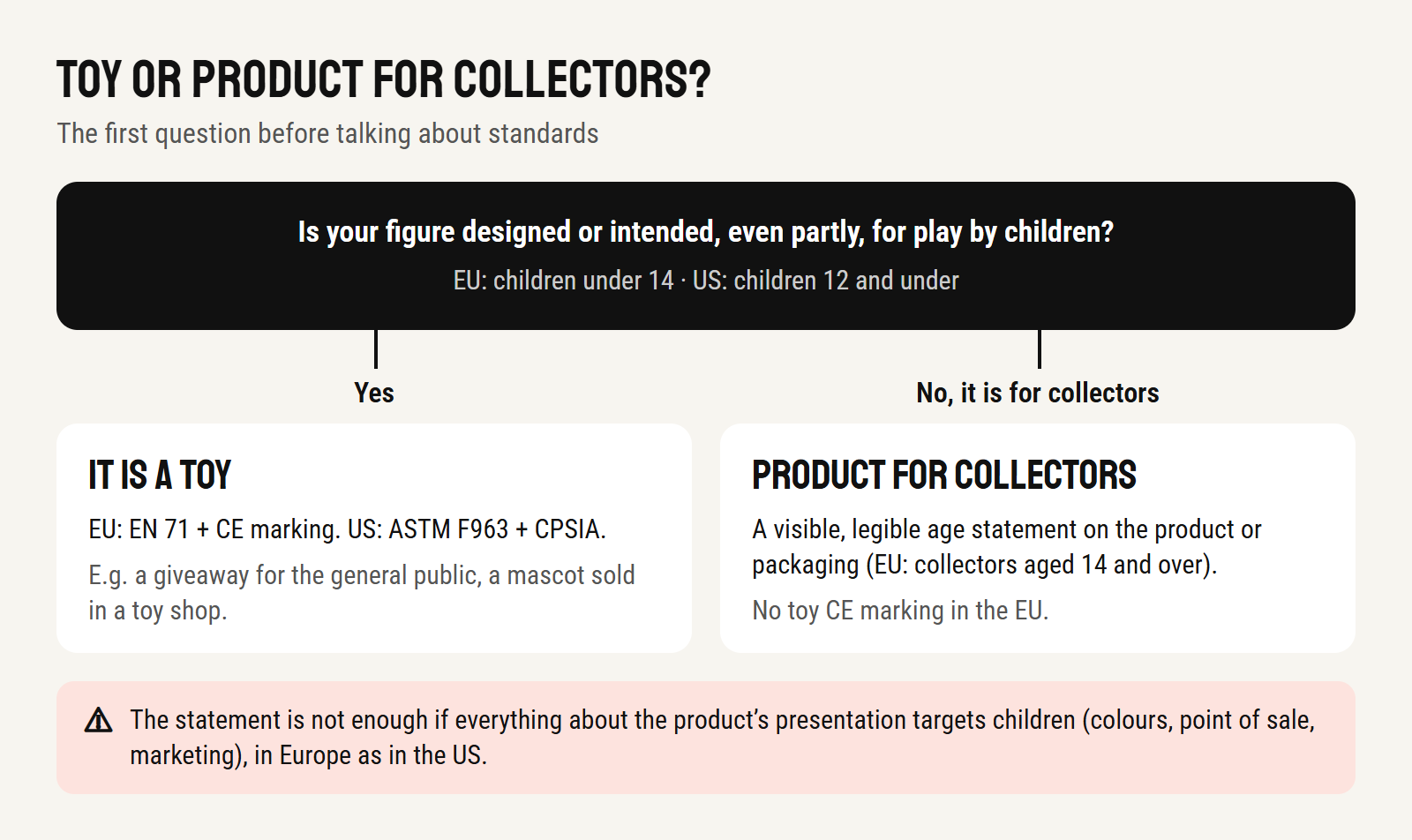
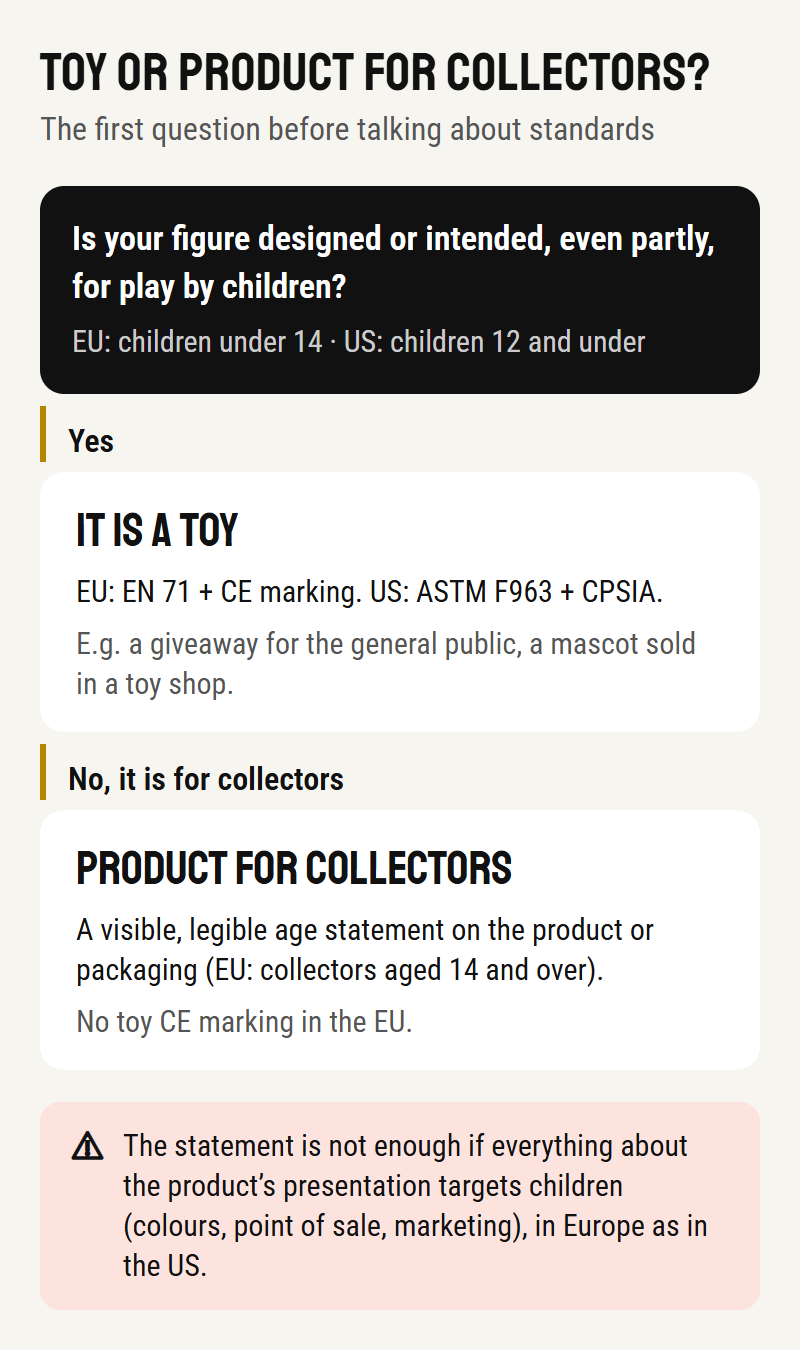
The first question to ask, in the EU and the US.
What does EN 71 cover?
EN 71 is the harmonised European toy safety standard. It has many parts; for a figure, three come up almost every time:
- EN 71-1 – Mechanical and physical properties: small parts that could be swallowed, sharp points and edges, strength of components, resistance to pulling and dropping.
- EN 71-2 – Flammability: how the materials behave near a flame.
- EN 71-3 – Migration of certain elements: presence and migration of chemical elements (heavy metals in particular) in materials and paints.
Other requirements can apply depending on the product (regulated chemical substances, plasticisers, etc.).
What is CE marking?
CE marking is affixed by whoever places the toy on the market to declare that it meets European requirements. It is not a quality label issued by a body: it is a commitment, which must be backed by:
- technical documentation (product description, safety assessment, test reports);
- a declaration of conformity;
- product traceability (batch number, contact details of the manufacturer or importer).
The marking must be visible, legible and indelible, on the toy or on its packaging.
What about Great Britain?
In Great Britain, toys must comply with the Toys (Safety) Regulations 2011, the UK version of the European rules. Toys can carry the UKCA marking, and the CE marking is currently still accepted; Northern Ireland follows EU rules. As these arrangements have changed several times, check the current government guidance before a launch in the UK, and make sure the labelling includes the details of the UK importer where required.
What does ASTM F963 and the CPSIA require in the US?
For toys intended for children 12 and under sold in the United States, the Consumer Product Safety Improvement Act (CPSIA) makes the ASTM F963 toy safety standard mandatory. In practice, this means:
- third-party testing by a laboratory accepted by the Consumer Product Safety Commission (CPSC);
- a Children’s Product Certificate (CPC), issued by the importer or domestic manufacturer, based on these tests;
- tracking labels on the product and its packaging, so the batch and origin can be traced;
- limits on lead in materials and paint and on certain phthalates;
- the small parts rules and the related choking hazard warnings for young children.
What should the label show?
Depending on the product’s status and the market, the labelling may include:
- the name and address of the manufacturer and, where applicable, the importer;
- a batch or series number for traceability;
- the CE marking (EU) or UKCA marking (Great Britain) for a toy;
- mandatory warnings, for example “Not suitable for children under 36 months. Contains small parts.” in the EU, or the choking hazard warning in the US;
- for a product for collectors, a visible and legible minimum age;
- the information in the language of the country of sale.
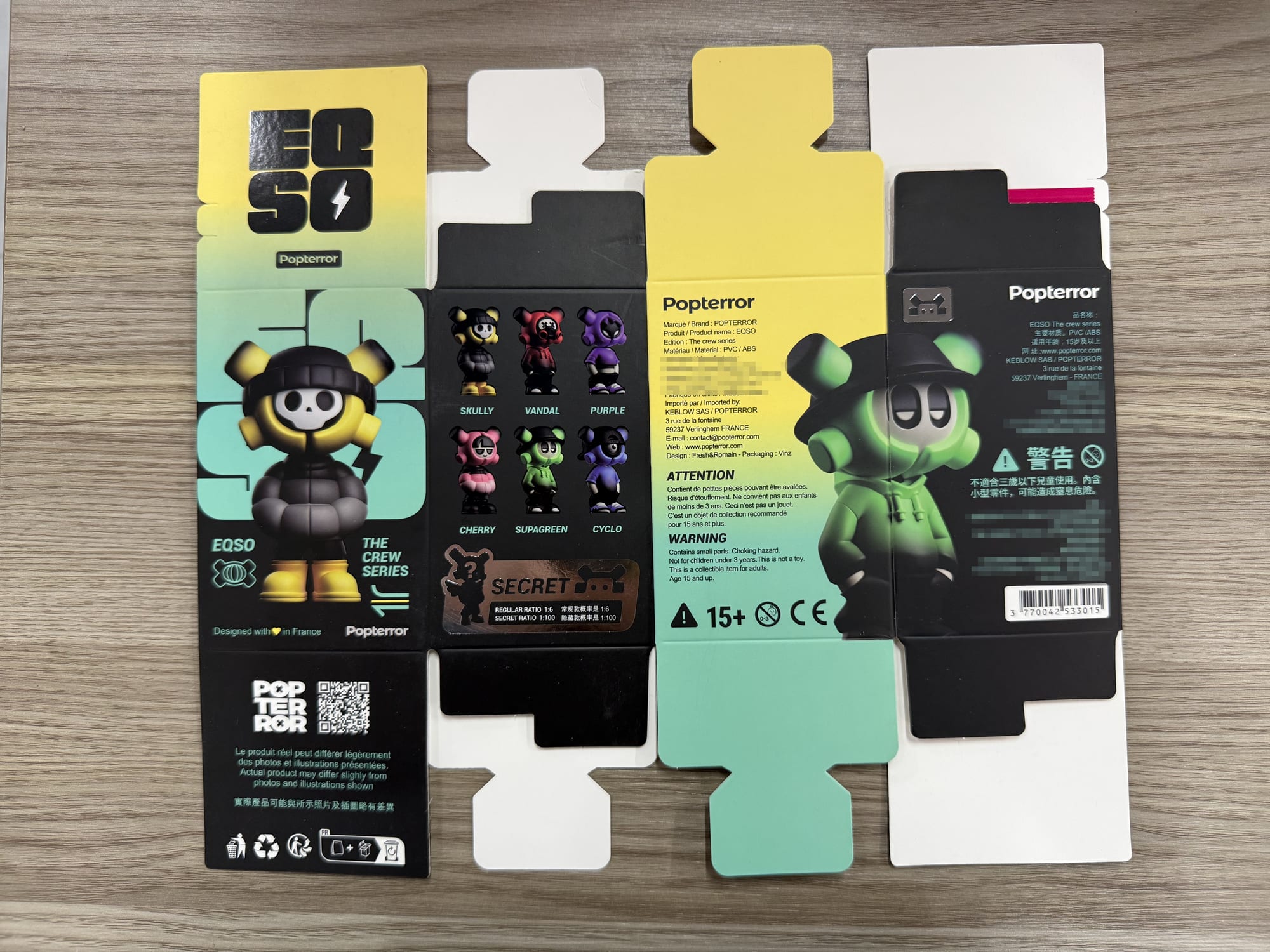
The EQSO The Crew boxes, laid flat: CE marking, 15+ age statement, small parts warning and importer details, in French, English and Chinese.
How does testing work?
Tests are carried out by specialised laboratories on samples taken from production (or from the pre-production run, in the same materials and paints). The laboratory issues a test report for each part of the standard checked.
A few tips:
- Plan ahead: testing takes time and has to be built into the schedule. At Popterror Studio, tests take place during the 2 weeks of quality control.
- Test every material and every colour: a new paint can change the EN 71-3 or lead test result.
- Keep the reports: a retailer, a marketplace or a market surveillance authority may ask for them.
- Test again if the product changes (new colour, new material supplier).
- Selling in several markets? Tell the laboratory from the start: many labs can combine EN 71 and ASTM F963 testing.
The case of blind boxes
A blind box contains figures that are often small, sometimes with accessories: small parts are a central question if the product is a toy. The mystery packaging must also respect consumer information rules. See our guide on how to make a blind box.
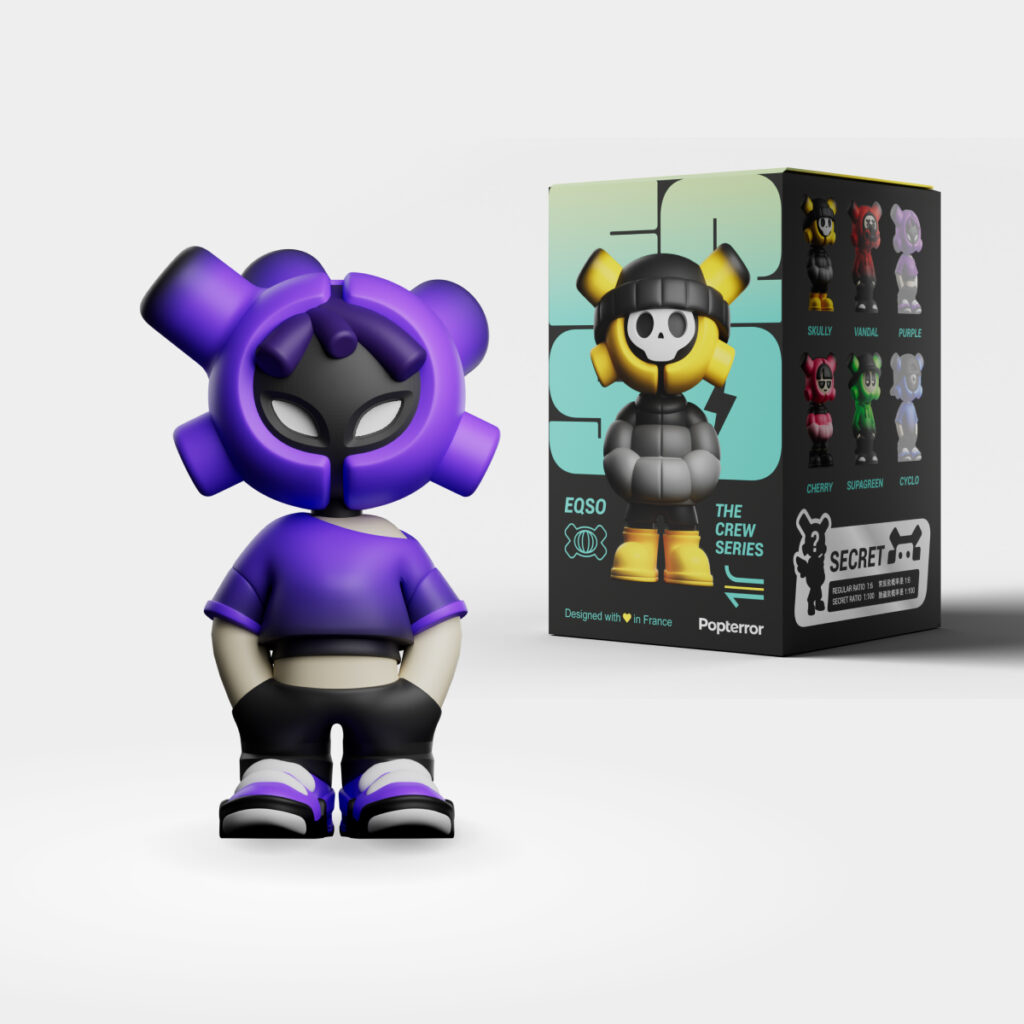
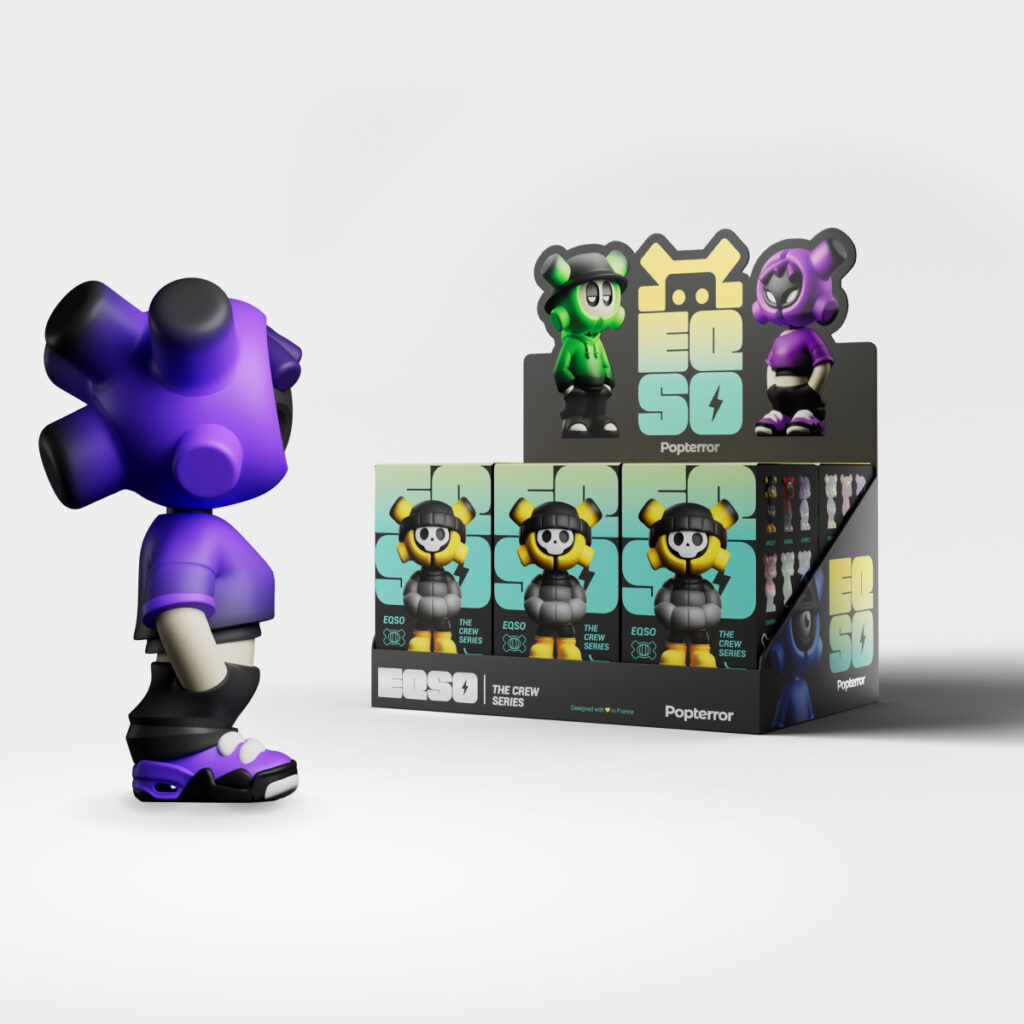
For our EQSO The Crew blind box, presented as a collectible, the age statement appears on the product: 15 and over.
Who is responsible?
The person responsible is whoever places the product on the market: in the EU, the manufacturer if it is established there, otherwise the importer; in the US, the importer or domestic manufacturer who issues the certificate. If your brand has figures produced abroad and imports them in its own name, it carries the responsibility for compliance. A studio like ours helps you prepare the tests, which are carried out by a specialised laboratory.
To put compliance in the context of the whole project, read our guide on how to make custom figures. And if you are preparing a production run, discover our custom figure manufacturing service and all our custom figure design and production services for brands.
Frequently asked questions
Is a collectible figure a toy?
It depends on how it is presented and who it is for. In the EU, a product designed or intended for play by children under 14 is a toy; products for collectors can be excluded if they carry a visible, legible indication that they are intended for collectors aged 14 and over. In the US, the question is whether the product is designed or intended primarily for children 12 and under. For each project, have your case checked by a specialised laboratory.
What is EN 71?
It is the European toy safety standard. It has several parts; for a figure, the most common are EN 71-1 (mechanical and physical properties), EN 71-2 (flammability) and EN 71-3 (migration of certain chemical elements).
What is ASTM F963?
It is the US standard consumer safety specification for toy safety. Under the Consumer Product Safety Improvement Act (CPSIA), it is mandatory for toys intended for children 12 and under sold in the United States, which must be tested by a laboratory accepted by the Consumer Product Safety Commission (CPSC).
Who is responsible for compliance?
Whoever places the product on the market: in the EU, the manufacturer if it is established there, otherwise the importer or authorised representative; in the US, the importer or domestic manufacturer issues the Children’s Product Certificate. If your brand imports the figures, it carries this responsibility.
How much does EN 71 or ASTM F963 testing cost?
The price depends on the number of parts tested, the number of materials and colours, and the laboratory. Market order of magnitude: around €300 to €3,000 per product.
Why do some figures say “14+” or “15+”?
In the EU, “14 and over” is the threshold set by the rules for products intended for collectors. Some brands show a higher age out of caution. On our EQSO The Crew blind box, the age shown is “15 and over”.
Related guides
Read next
How to make custom figures: the complete guide, from idea to factory
How to make custom figures in series: character design, 3D modelling, prototype, materials, moulds, production, quality control, packaging and shipping.
Manufacturing figures in China or Europe: an honest comparison
Should you manufacture figures in China or Europe? Know-how, prices, quantities, lead times, shipping, duties and quality control: a studio’s honest view.
How to make a blind box: the mechanic, chase figures and odds
How to make a blind box: number of characters, chase figure, odds, mystery packaging and a duplicate-free display. The method behind our EQSO blind box.