Complete guide · Popterror Studio
How to make custom figures: the complete guide, from idea to factory
 By Romain Czysz, 3D artist, co-founder of PopterrorPublished Updated Reading time: 13 min
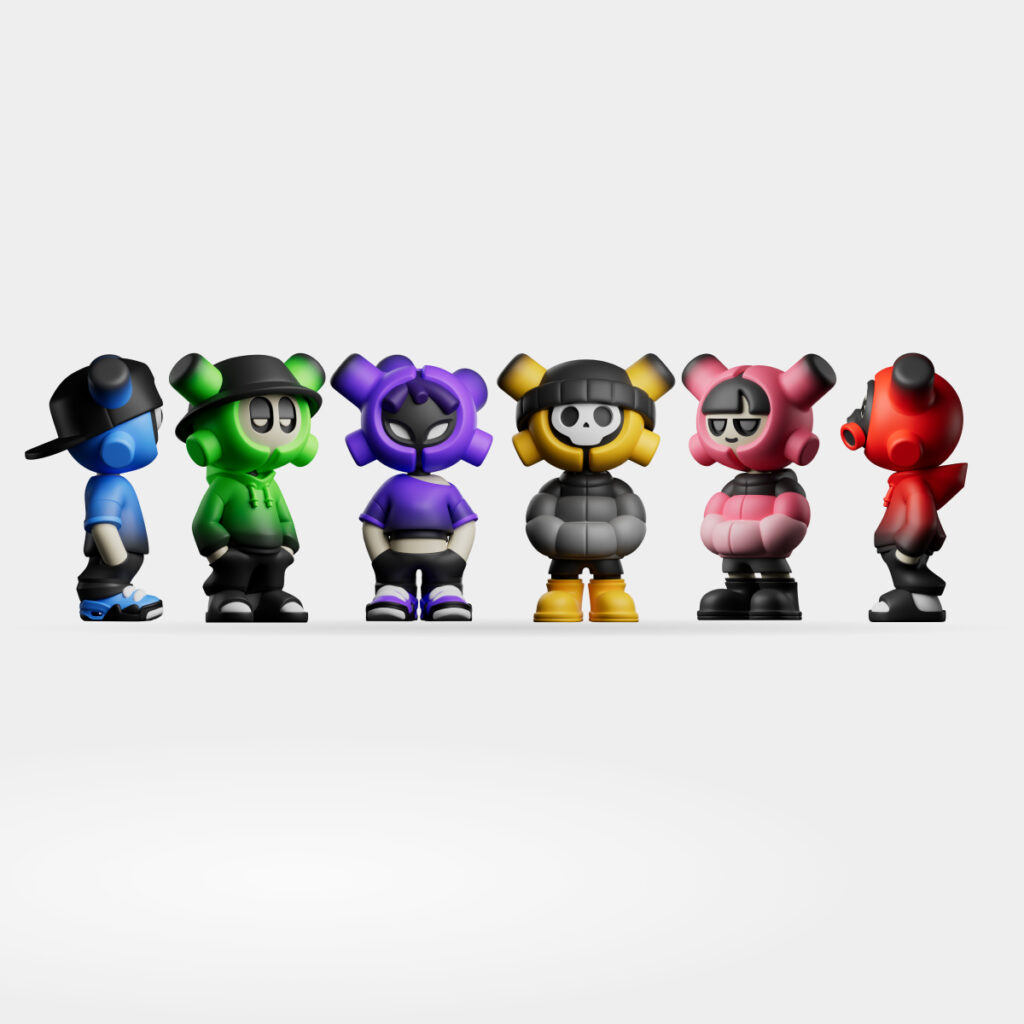
The short answer
To make custom figures in series, you go through ten steps: character design, a 3D model built for manufacturing, a 3D-printed prototype, choosing the material (vinyl, PVC or resin), making the moulds and a pre-production sample, production and painting, quality control, packaging, safety testing, then shipping. Allow 6 to 8 months from idea to delivery for an existing character, and 7 to 9 months if the character also has to be created.
You want to make custom figures for your brand, your project or your community, and you don’t know where to start? This guide takes you from the idea to the delivered cartons, step by step. It is based on our own experience: at Popterror, we designed, prototyped, produced and sold our EQSO art toys, then our blind box EQSO The Crew.
Before you start: which questions should you ask?
Design is not the first step. The first step is knowing why you are making this figure. Five questions will shape the rest of the project.
1. What is the goal? Selling the figure as a product in its own right, giving it to your customers, handing it out at an event, launching a collection over several years… A product sold in shops does not have the same requirements as a corporate gift.
2. Who is it for? Adult collectors, fans of a brand, children, business customers? The answer changes the design, the acceptable price and, above all, the safety rules: a figure that may end up in a child’s hands is a toy in the eyes of the law.
3. How many pieces? This is the question that weighs most on the budget and on the choice of technique. You don’t make 200 pieces the way you make 10,000. If you are unsure, our guide to the minimum order quantity for custom figures will help you decide.
4. What budget? Separate the fixed costs (design, 3D, prototype, moulds), paid once, from the cost per piece (material, paint, packaging, shipping). For a first idea, use our custom figure cost estimator.
5. What will you sell it for? If the figure is sold, start from the target retail price and work backwards: retailer margin, your margin, shipping, taxes… The acceptable production cost follows directly.
The 10 steps at a glance
Before going into detail, here is the big picture. Keep this table handy: it works as a checklist throughout the project.
| Step | What happens | What you approve |
|---|---|---|
| 1. Design | Brief, sketches, turnaround | The character and its colours |
| 2. 3D modelling | Volume, part splitting, wall thickness | The 3D model from every angle |
| 3. Prototype | Resin 3D print, Pantone references | The prototype in your hands |
| 4. Material | Vinyl, PVC or resin depending on quantity | The technique and the budget |
| 5. Moulds and pre-production | Tooling, first “factory” sample | The signed pre-production sample |
| 6. Production | Moulding, painting, assembly | The start of the run |
| 7. Quality control | Batch inspection | The inspection reports |
| 8. Packaging | Box, blind box, display, certificate | The print proofs |
| 9. Compliance | Safety tests, marking, labelling | The test reports |
| 10. Shipping | Sea or air freight, customs, storage | Receipt of the cartons |
Two rules run through the whole project. First, the later a change comes, the more it costs: a change on a sketch takes a few minutes, the same change on a steel mould can cost part of the tooling. Second, every step has a deliverable approved in writing: a sketch, a file, a prototype, a sample. That is what prevents misunderstandings between the brand, the studio and the factory.
Step 1: how do you design a character that can be manufactured?
Everything starts with a character. Either you already have one (a mascot, an animated logo, a comic book hero), or it has to be created. Either way, the design has to serve two masters: your brand and the factory.
The brief
A good brief fits on one page: the character’s story, its personality, the brand’s values, the audience, the intended uses (figure, but also social media, packaging, animation), size and budget constraints, and visual references you love… or hate.
The sketches
The designer explores several directions: silhouettes, proportions, attitudes, accessories. At this stage, what matters most is readability: a good character is recognisable from its silhouette alone. Ideas that are hard to manufacture are dropped early, such as very thin parts that would break, or an unstable pose that would make the figure fall over.
The turnaround
Once a direction is chosen, the character is drawn from every angle: front, side, back, sometimes three-quarter. This is called the turnaround. It is essential for the 3D modeller, who should not have to invent anything. Reference colours and details (logos, patterns) are added to it.
To go further on this step, read our guide on how to create a brand mascot, or discover our custom mascot design service.
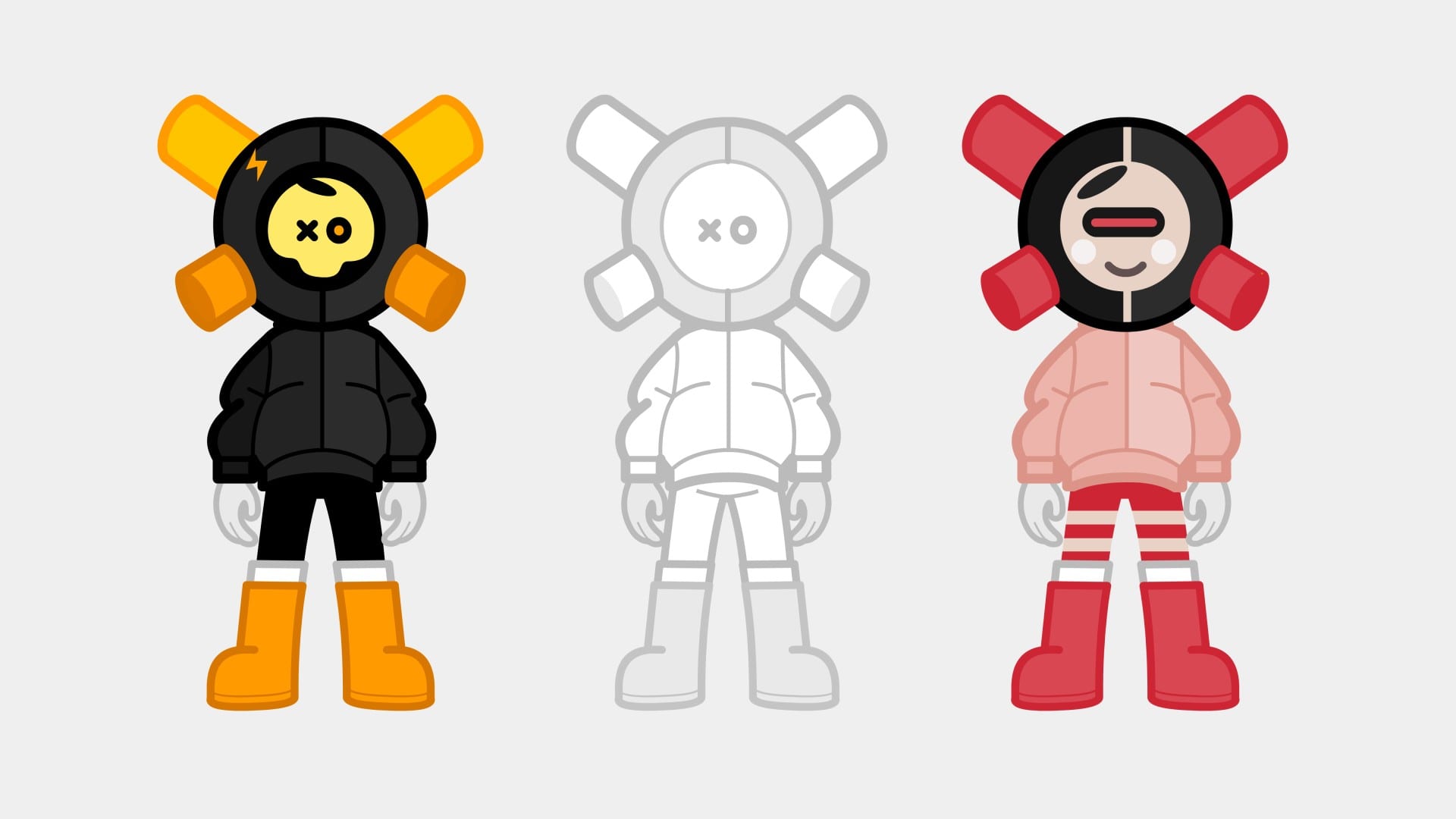
2D drawings of EQSO: one silhouette, worked into several colour versions.
Step 2: how do you model a figure for production?
3D modelling turns the drawing into a volume. But a model that looks great in a render is not necessarily a good model for the factory. Production 3D has to anticipate several constraints.
Part splitting. A figure is rarely moulded in one piece. Head, arms and accessories are often separate parts, assembled afterwards. The modeller decides where to cut so that the joins are discreet and each part can come out of the mould.
Wall thickness. Walls that are too thin break or warp; walls that are too thick waste material and can shrink as they cool. The ideal thickness depends on the material: we set it with the factory from the modelling stage.
Undercuts. An undercut is a shape that “hooks” into the mould and stops the part from coming out (an arm folded under the body, for example). They have to be avoided, split differently, or handled with more complex, and therefore more expensive, moulds.
Stability. A figure has to stand up. We check the centre of gravity and the surface of the feet, and sometimes add a base or magnets.
At Popterror, this step is our speciality: Romain comes from 3D visual effects and automotive design, two fields where a volume has to be both beautiful and realistic.
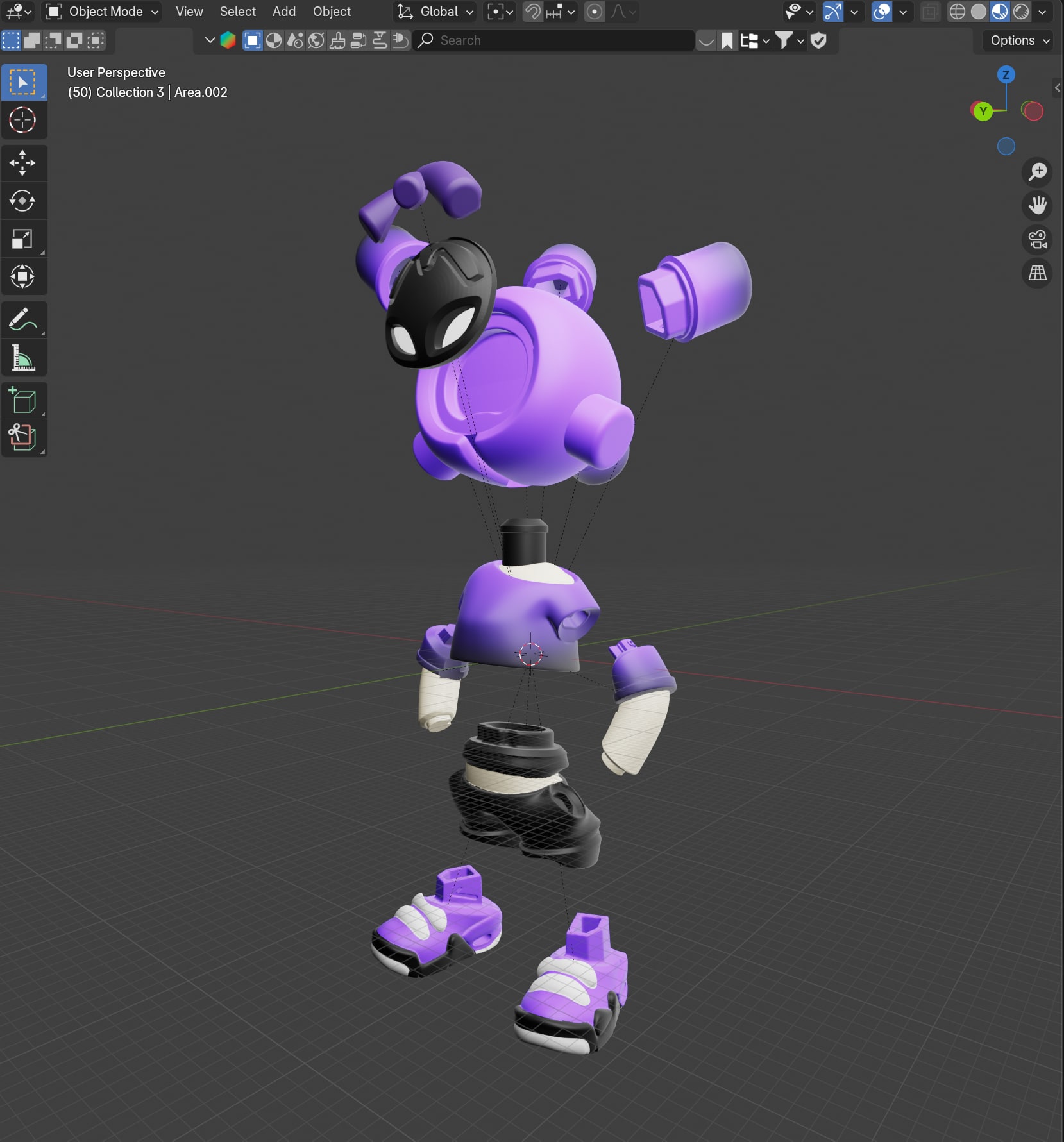
The 3D model of an EQSO The Crew figure in exploded view: head, mask, torso, arms, legs and shoes are separate parts, designed for moulding.
Step 3: what is the prototype for?
The prototype is the first physical version of your figure. It is almost always 3D-printed in resin, a technique that reproduces very fine detail and allows quick corrections.
The prototype is used to:
- check volumes and proportions: what looks right on screen can feel too bulky or too fragile in the hand;
- test stability and how the parts fit together;
- check readability at real size: a facial detail visible at 12.5 cm sometimes disappears at 8 cm;
- lock the colours: each area is matched to a Pantone reference, so that the factory reproduces exactly the right shade.
It often takes a few rounds before the prototype is approved. That is normal, and fixing things here is much cheaper than after the moulds are made. Allow 3 days to print a prototype, plus time for corrections.
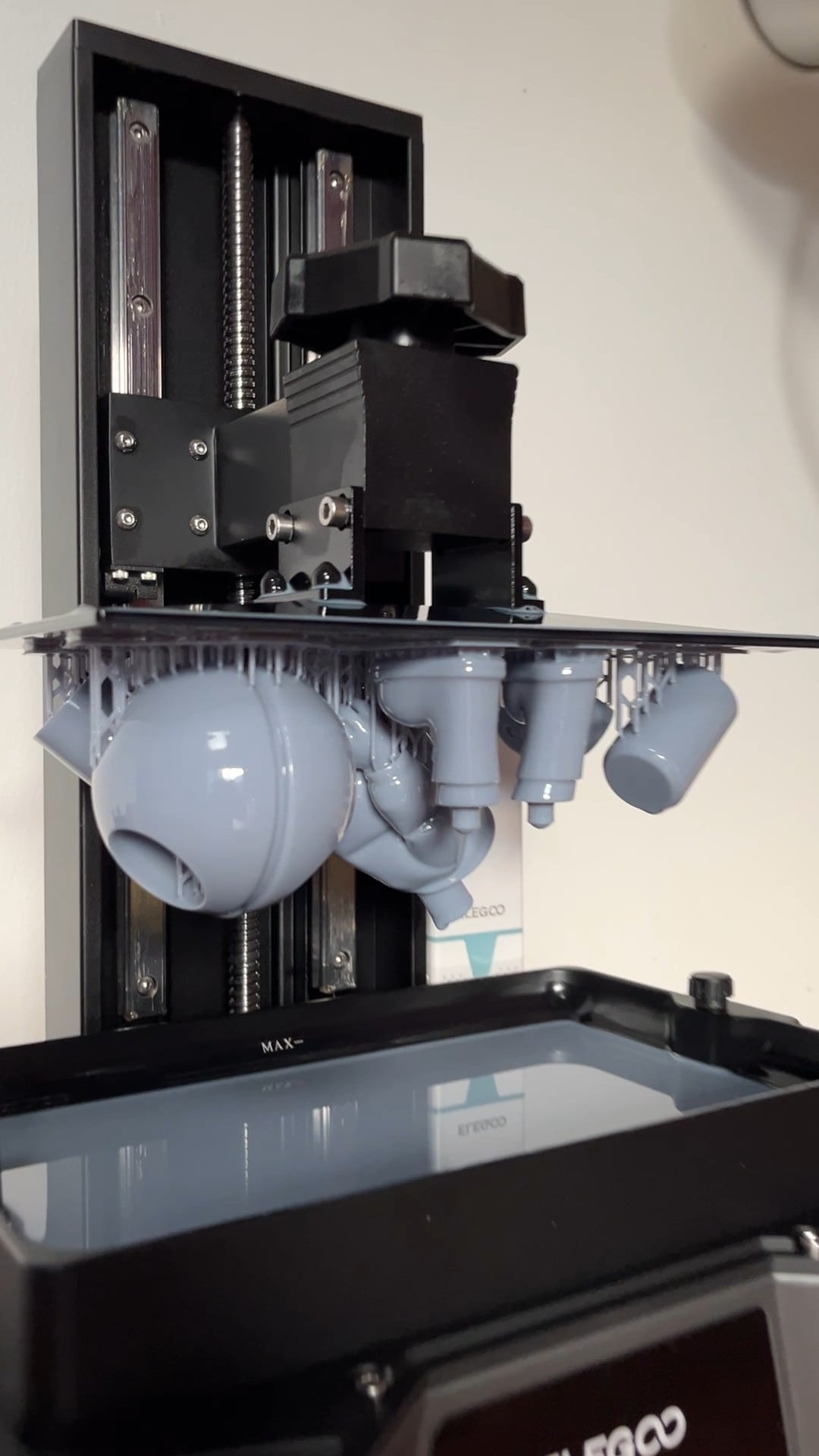
The parts of one of our prototypes, 3D-printed in resin, still attached to the printer’s build plate with their supports.
Step 4: which material and technique should you choose?
The choice of material depends on quantity, size, the finish you want and budget. Here are the three main families used for brand figures and art toys.
| Criterion | Rotocast vinyl | Injected PVC | Resin |
|---|---|---|---|
| Principle | Liquid material coats the inside of a rotating mould | Molten plastic injected under pressure into a steel mould | Liquid resin cast into a silicone mould |
| Type of part | Hollow, light | Solid, precise | Solid, heavy |
| Suitable run | Medium to large | Large to very large | Very small |
| Mould cost | Medium | High | Low |
| Unit price | Medium | Low in large runs | High (labour) |
| Finish | Matte, soft, typical of art toys | Precise, fine detail | Very detailed, statue-like |
| Indicative minimum quantity | 300 pieces (our minimum) | 1,000 pieces (our minimum) | Around fifty pieces (not offered by the Studio) |
In short: PVC injection is expensive upfront because of its steel tooling, but brings the unit price down sharply in large runs. Resin suits very small runs but takes more manual labour. Rotocast vinyl gives hollow, light parts with the matte finish people associate with art toys and designer vinyl toys, like our EQSO figures.
The full comparison is in our guide vinyl vs PVC vs resin figures: which one to choose?.
Step 5: how are the moulds and the pre-production sample made?
Once the prototype is approved, the factory makes the moulds (molds, in US spelling). For injection, they are machined steel blocks; for vinyl, metal moulds suited to rotocasting; for resin, silicone moulds. You generally need one mould per part, sometimes with several cavities per mould to produce faster. All the details are in our guide to figure moulds: steel, metal or silicone.
With these moulds, the factory produces a pre-production sample, also called the “golden sample”. It is the figure exactly as it will come off the line: right material, right paint, right assembly. It is the reference for the whole production: you approve it, you sign it off, and every piece produced must match it.
Never skip this step. Once production has started, fixing a defect costs far more.
Step 6: how do series production and painting work?
Production goes through moulding the parts, deflashing (removing small excess material), painting, then assembly.
Painting uses several techniques, often combined:
- spray painting (airbrush), with masks, for large areas and gradients;
- pad printing, a silicone pad that transfers a precise design: eyes, logos, small details;
- hand finishing, for details that cannot be automated.
Each extra colour adds a step, and therefore time and cost. That is why the palette is often limited, without losing character. Special effects (metallic, glow-in-the-dark, flocking) are added at this stage.
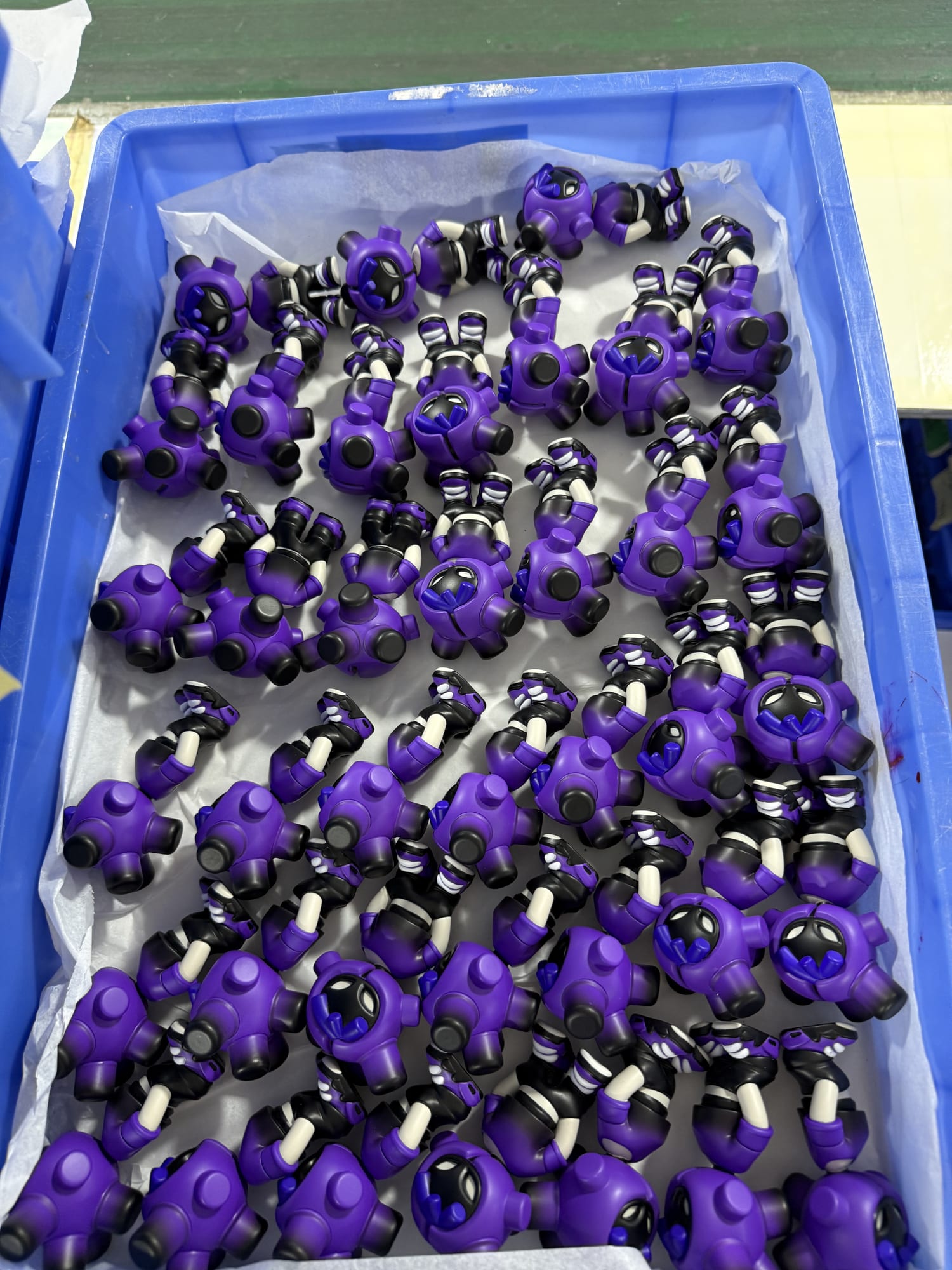
Heads and bodies of an EQSO The Crew figure in our partner factory: moulded, painted and ready for assembly.
Step 7: how do you control quality?
Quality control checks that every batch matches the approved pre-production sample. It looks at:
- shapes: no warping, no bubbles, no badly demoulded parts;
- paint: colours matching the Pantone references, no smudges, patterns in the right place;
- assembly: parts firmly attached, figure stable;
- packing: the right figure in the right box (essential for a blind box).
Inspection is done by sampling during and after production, with photos, reports and ideally an on-site visit. Our method: before the run, we send you samples to approve; during production, we follow our partner factory closely, and our team goes on site (visit in October 2026).
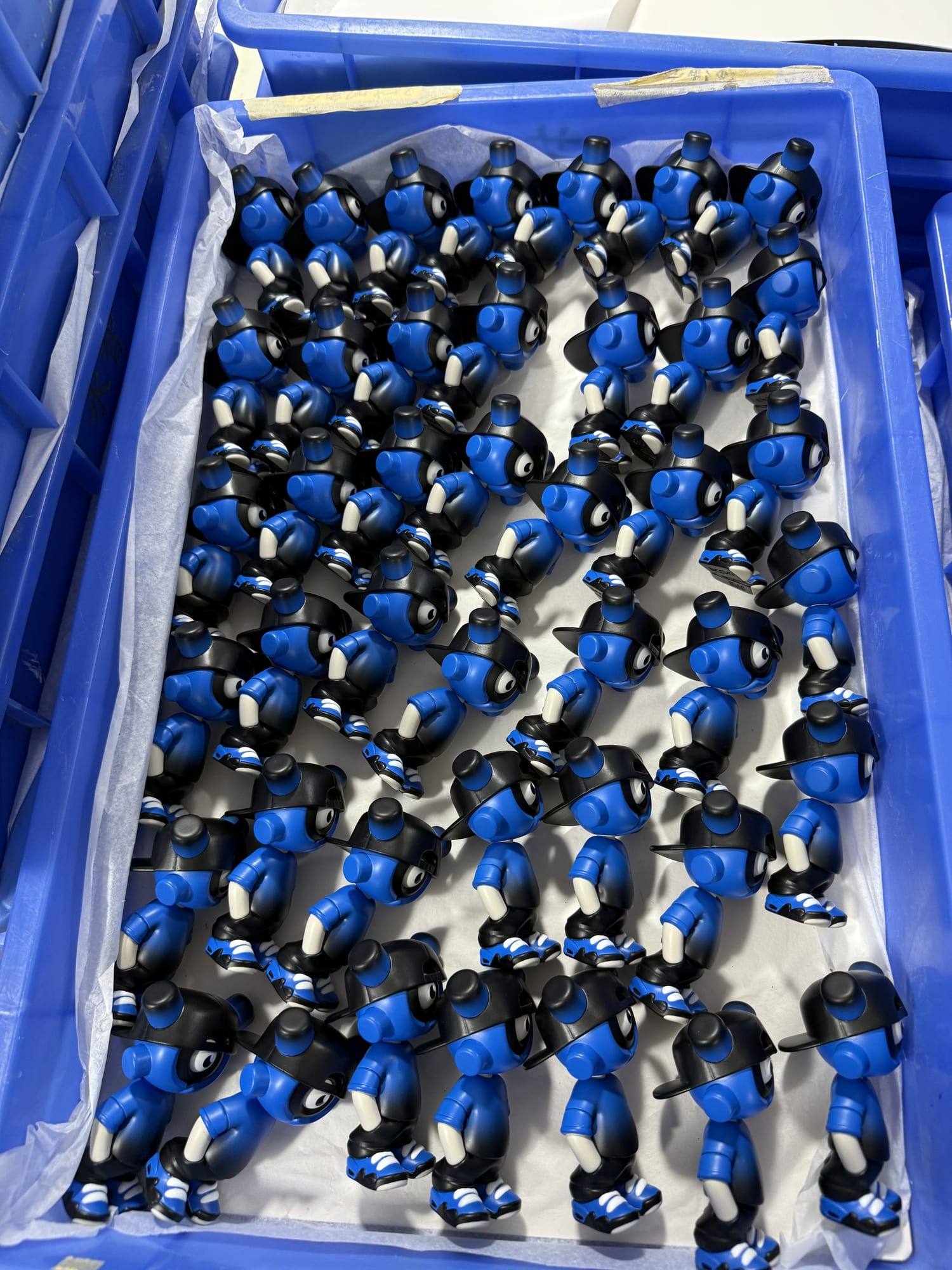
A tray of assembled EQSO The Crew figures in our partner factory in China.
Step 8: which packaging should you choose?
Packaging is part of the product. For a collectible, it is sometimes kept more carefully than the figure itself. The most common options:
- the polybag: economical, for giveaways and free figures;
- the printed box: for retail, carrying your graphic universe;
- the collector box: rigid, with an insert and sometimes a window, for limited editions;
- the blind box and its display: mystery boxes grouped in a counter display.
A certificate of authenticity, numbered and signed, is often added to give value to limited editions. All our EQSO figures come with one.
Packaging is designed at the same time as the figure: its size, insert and printing have their own production times. For mystery boxes, read our guide on how to make a blind box.
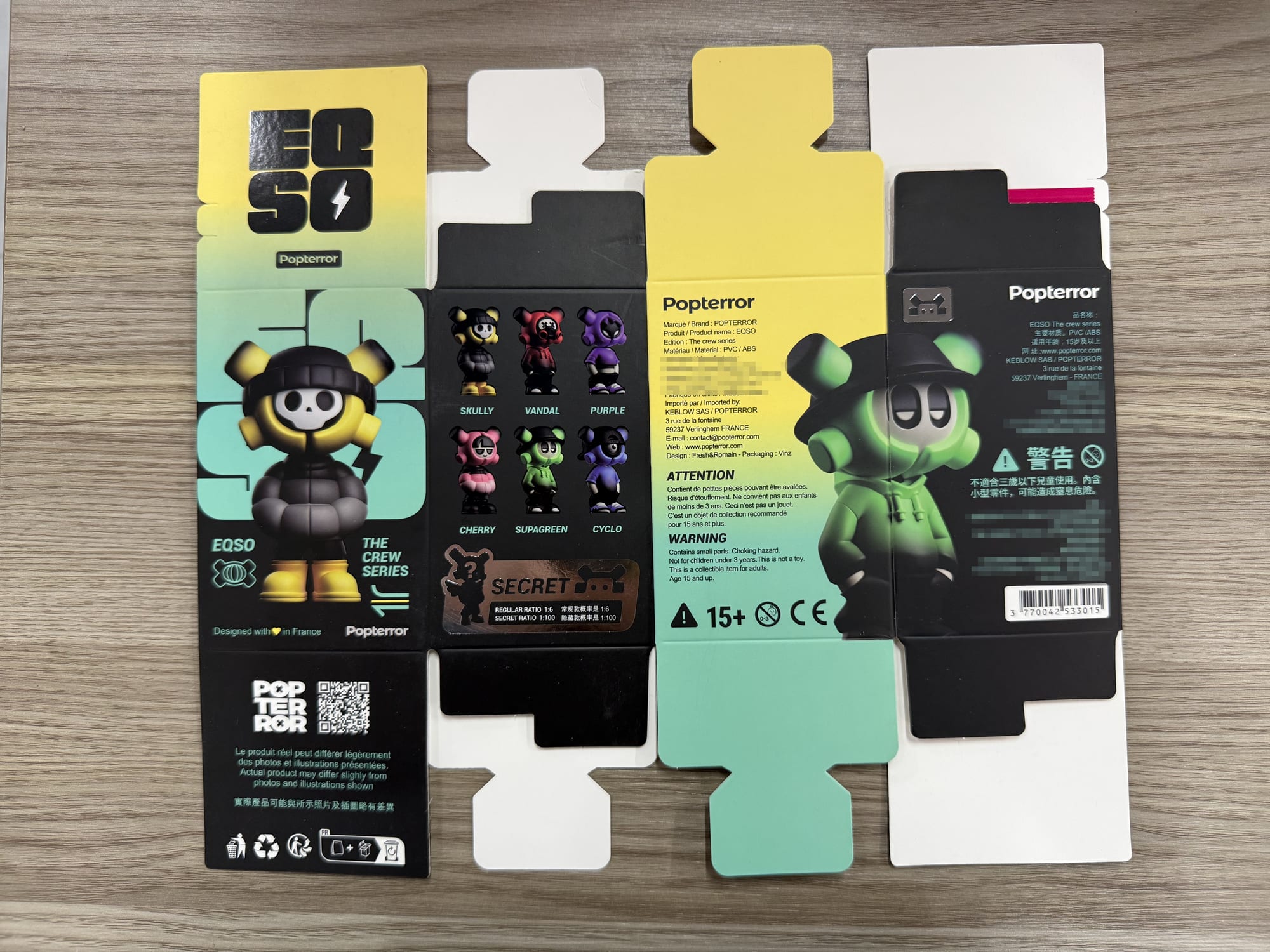
The EQSO The Crew blind boxes, printed and still flat: artwork, character list, legal notices and warnings.
Step 9: which safety standards and compliance rules apply?
This is the most often forgotten step, and the riskiest one. The rules depend on where you sell.
Toy or collectible? In the European Union, a product designed or intended for play by children under 14 is a toy: it must meet the toy safety rules, with the EN 71 standard, CE marking and technical documentation. A collectible reserved for adults follows other rules, but must be clearly presented as such (age warning, presentation, point of sale). EU toy legislation is changing: a new regulation is replacing the 2009 directive, with a transition period. Check the text in force at your launch with a specialised laboratory or a lawyer.
In Great Britain, toys must comply with the UK toy safety regulations and carry the appropriate conformity marking; the rules on UKCA and CE marking have changed several times since Brexit, so check the current guidance.
In the United States, children’s toys (for children 12 and under) must comply with the ASTM F963 standard under the CPSIA, be tested by a laboratory accepted by the US Consumer Product Safety Commission and come with a Children’s Product Certificate.
EN 71 has several parts. The most common for a figure are EN 71-1 (mechanical and physical properties: small parts, points, edges), EN 71-2 (flammability) and EN 71-3 (migration of certain chemical elements, as in paints).
Age and labelling. Depending on the case, you must show the minimum age, warnings (small parts, for example), the name and address of whoever places the product on the market, and a batch number for traceability.
Test reports. Tests are carried out by specialised laboratories on production samples. Keep the reports: a retailer or a market surveillance authority may ask for them. As a rough guide, testing costs around €300 to €3,000 per product, depending on materials and the number of colours. At Popterror Studio, tests take place during the 2 weeks of quality control.
Everything is detailed in our guide to figure safety standards: EN 71, CE, UKCA and ASTM F963.
Step 10: how do you handle shipping, customs and storage?
Once produced and packed, the figures have to reach you.
Shipping. From Asia, there are two main options: sea freight, cheap but slow, and air freight, fast but expensive. The choice depends on volume, weight and your launch date. Typical transit times: 6 to 8 weeks by sea, 10 to 15 days by air.
Customs. On arrival, the goods are cleared through customs: duties depending on the product category and the destination country, import VAT or sales taxes, documents (invoice, packing list, certificate of origin if needed). Duties change over time, and US tariffs on goods made in China have changed several times recently: check them when you plan your budget. The delivery terms (the “Incoterms”) state who pays for what. At Popterror Studio, shipping and customs are included in the quote, and we deliver worldwide, with rare exceptions.
Storage. Plan where the cartons will go: to you, to a logistics provider, or straight to your retailers. Figures don’t like heat or crushing: store them somewhere dry, out of the sun, without stacking too high.
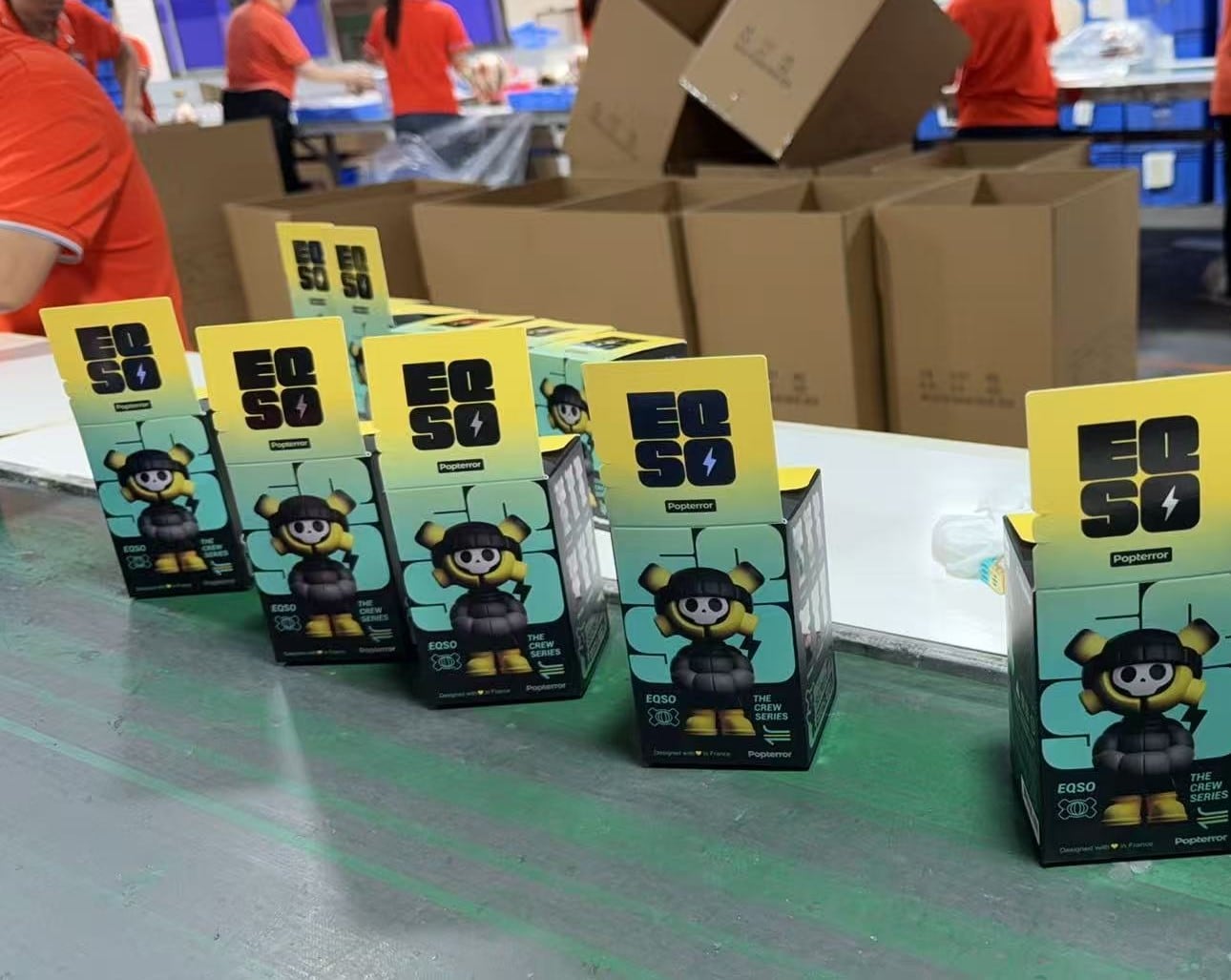
EQSO The Crew boxes and shipping cartons in our partner factory.
How long does it take in total?
Here is the full sequence of steps, from brief to delivery. Some can overlap (packaging is designed during production, for example), but the overall order stays the same.
- 1. Brief and character design: 2 to 4 weeks
- 2. Production 3D modelling: 2 weeks
- 3. Prototype: 3 days
- 4. Moulds: 1 month
- 5. Pre-production sample: 2 weeks
- 6. Production and painting: 1 month
- 7. Quality control, safety tests and packaging: 2 weeks
- 8. Shipping and customs: 6 to 8 weeks by sea (10 to 15 days by air)
Step widths are proportional to their typical duration, not counting approval time on your side.
Usual total for a full project, counting approval rounds and sea freight: 6 to 8 months for an existing character, 7 to 9 months if the character has to be created or for a blind box. For the step-by-step detail and tips to save time, read our guide on how long it takes to make a figure.
How much does it cost to make a custom figure?
The budget splits into two main families of costs.
Fixed costs, paid once whatever the quantity:
- character design;
- production 3D modelling;
- the prototype(s);
- the moulds (often the biggest item);
- safety testing.
Variable costs, multiplied by the number of pieces:
- material;
- painting and assembly;
- packaging;
- shipping and customs duties.
That is why the unit price falls as the quantity grows: fixed costs are spread over more pieces. For market orders of magnitude item by item, read our guide how much does it cost to make a custom figure?.
To get a range tailored to your project in two minutes, use our custom figure cost estimator.
What are the 10 mistakes to avoid?
- Drawing before defining the goal and the quantity. The design depends on the technique, which depends on the quantity.
- Choosing a design that cannot be manufactured: parts too thin, unstable pose, undercuts everywhere.
- Skipping the prototype to save time. You will lose a hundred times more on the moulds.
- Adding colours without measuring their impact on cost and lead time.
- Not locking colour references (Pantone): every screen shows colours differently.
- Approving production without a signed pre-production sample.
- Forgetting compliance: a figure that may end up in a child’s hands is a toy.
- Thinking about packaging too late, when it has its own lead times.
- Underestimating shipping and customs, in cost as well as in time.
- Setting a launch date with no margin. A production or shipping hiccup almost always happens.
Our experience: EQSO The Crew
Preparing a figure project and want a single point of contact from sketch to delivery? That is the core of our custom figure design and production for brands, and of our custom figure manufacturing service.
Frequently asked questions
What is the first step to make a custom figure?
Define the project before drawing anything: what the figure is for, who it is for, how many pieces, what budget and what retail price. These answers drive everything else, from the material to the packaging.
Can you make custom figures in small quantities?
Yes, but the technique changes: resin cast in silicone moulds suits very small runs, while vinyl and especially injected PVC need more expensive moulds that only pay off above a certain volume. At Popterror Studio, we produce from 300 pieces in vinyl and 1,000 pieces in PVC; resin, possible from around fifty pieces, is not part of our offer.
How long does it take to make a custom figure?
Between the first sketch and delivery, you have to go through design, 3D, prototype, moulds, pre-production, production and shipping. Typical total: 6 to 8 months for an existing character, 7 to 9 months if it has to be created. Sea freight alone often takes several weeks.
Do you need a 3D file to make a figure?
Yes: today almost every figure goes through a 3D model, used to print the prototype and then to make the moulds (molds, in US spelling). If you only have a drawing, the studio turns it into a manufacturable 3D model.
Does a collectible figure have to meet toy safety standards?
If it is likely to be used as a toy by a child, it must meet toy safety rules: EN 71 and CE marking in the EU, the UK toy regulations in Great Britain, ASTM F963 and the CPSIA in the United States. A collectible for adults follows other rules but must be clearly presented as such. Have your case checked by a specialised laboratory before launch.
Where should you manufacture figures: Asia or Europe?
Most vinyl and PVC figures are produced in Asia, where the industrial know-how is. Europe can suit small runs or certain techniques. We cover the pros and cons in our dedicated guide.
Related guides
Read next
How much does it cost to make a custom figure? Every cost explained
Custom figure cost explained: fixed costs (design, 3D, moulds), cost per piece, how quantity changes the unit price, and tips to keep your budget in check.
Vinyl vs PVC vs resin figures: which material should you choose?
Vinyl or resin figure? Rotocast vinyl, injected PVC and resin compared (finish, quantity, cost, lead time) to help you choose the right material.
How long does it take to make a custom figure? Lead times step by step
How long does it take to make a custom figure? Lead time for each step (design, 3D, prototype, moulds, production, shipping) and planning tips.