Guide · Popterror Studio
How much does it cost to make a custom figure? Every cost explained
 By Romain Czysz, 3D artist, co-founder of PopterrorPublished Updated Reading time: 5 min
The short answer
The cost of a figure is made of fixed costs paid once (design, 3D modelling, prototype, moulds, safety tests) and a cost per piece (material, paint, packaging, shipping). The larger the quantity, the more the fixed costs are spread out and the lower the unit price. Market orders of magnitude, excluding tooling, for a figure of around ten centimetres: often over €20 per piece below 500 pieces, €6 to €10 at about 2,000 pieces in vinyl, and under €5 from 5,000 pieces in PVC.
“How much does a figure cost?” It is the first question brands ask us, and the hardest one to answer in a sentence. Two figures that look alike can have very different prices depending on quantity, technique and finishes. This guide gives you the keys to read a quote, build your budget and know where you can save.
How is the price of a custom figure built?
The price of a figure project reads in two columns.
Fixed costs: you pay them once, whether you produce 200 or 20,000 pieces. They cover design, 3D modelling, the prototype, the moulds and safety testing.
Variable costs: they repeat for every piece. They cover material, painting, assembly, packaging, then shipping and taxes.
The unit price is therefore:
Price per piece = (fixed costs ÷ quantity) + variable cost per piece
This formula explains almost everything: why small runs are expensive per piece, why large runs become attractive, and why the choice of technique matters so much.
What are the fixed costs of a figure project?
The orders of magnitude below are prices observed on the figure market (manufacturers and specialised laboratories, 2025–2026), rounded. Most of our sources quote in US dollars; at current exchange rates, the dollar amounts are of the same order. They help you place your budget, not replace a quote.
| Item | What it is for | Market order of magnitude |
|---|---|---|
| Character design | Sketches, directions, turnaround, colours | Quoted per project, depending on the starting point |
| Production 3D modelling | Manufacturable volume, part splitting | €300 to €1,000 per working day: up to 3 days for a simple character, more than 6 days for a complex one |
| Prototype | Resin 3D print, corrections | Often invoiced together with the tooling |
| Moulds | Tooling for series production | Vinyl: €1,500 to €3,500 per 15–20 cm figure. PVC: from around €3,000. Tooling and prototyping together: often €6,000 to €18,000 or more |
| Pre-production sample | First “factory” figure to approve | Included or invoiced separately, depending on the manufacturer |
| Safety testing | EN 71, ASTM F963 or other standards as needed | €300 to €3,000 per product, depending on materials and number of colours |
Design depends mostly on the starting point: a production-ready 3D file, an existing drawing to turn into a volume, or a character to create from scratch. If you are starting from nothing, our custom mascot design service covers this step.
Moulds (molds, in US spelling) are generally the biggest item. Their cost depends on the technique (steel for injection costs much more than silicone for resin), the size of the figure and the number of parts to mould. A blind box of six characters needs six sets of moulds. To understand it all, read our guide to figure moulds: steel, metal or silicone.
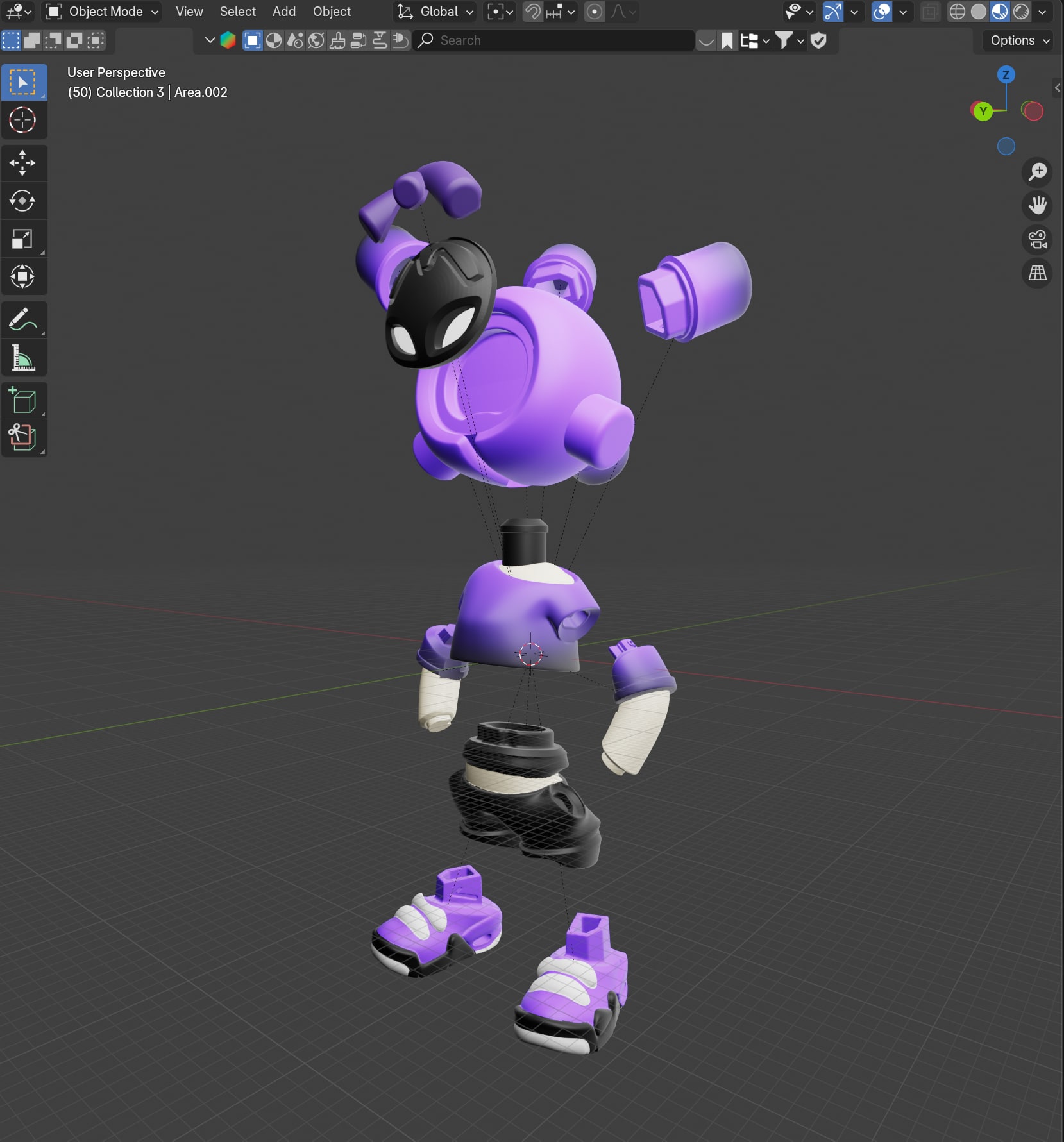
The 3D model of an EQSO The Crew figure in exploded view: the more parts there are to mould, the more the tooling costs.
What are the costs per piece?
- Material: its price varies with the material (vinyl, PVC, resin) and the weight of the figure.
- Painting: each colour, each pad-printed pattern and each hand finish adds time.
- Assembly: the more parts to glue or fit together, the longer it takes.
- Packaging: from a simple polybag to a collector box with insert and certificate, the gap is significant.
- Shipping: sea or air, carton volume, distance.
- Taxes: customs duties and import VAT or sales taxes, depending on the destination country.
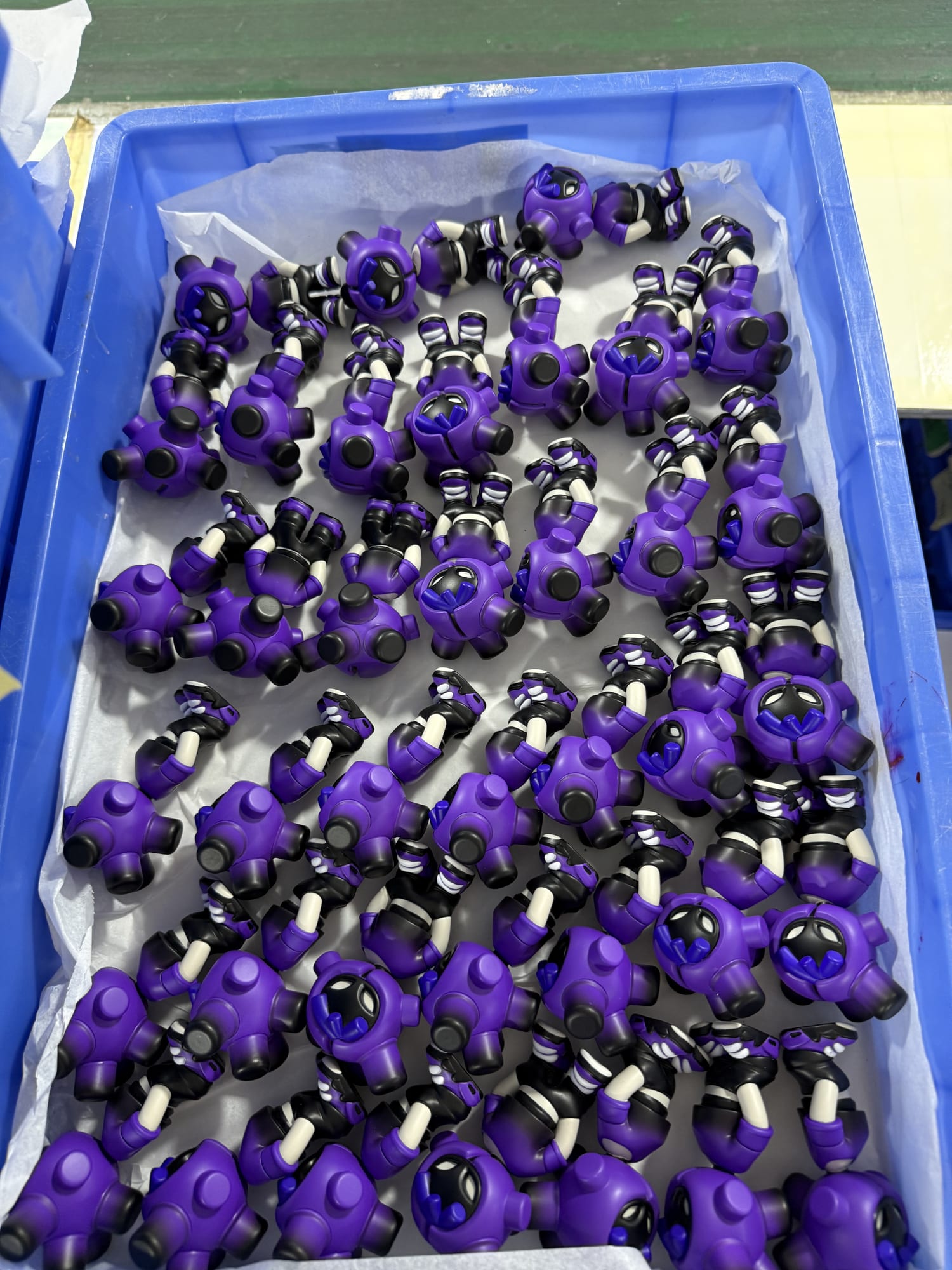
Heads and bodies of an EQSO The Crew figure, painted before assembly: painting and assembly are part of the cost per piece.
Why does the unit price fall as the quantity grows?
Back to the formula. Here is a fictional example to illustrate the calculation: a project with €10,000 of fixed costs and a variable cost of €5 per piece.
| Quantity | Share of fixed costs per piece | Total unit price |
|---|---|---|
| Small run (500 pieces) | €20 | €25 |
| Medium run (2,000 pieces) | €5 | €10 |
| Large run (10,000 pieces) | €1 | €6 |
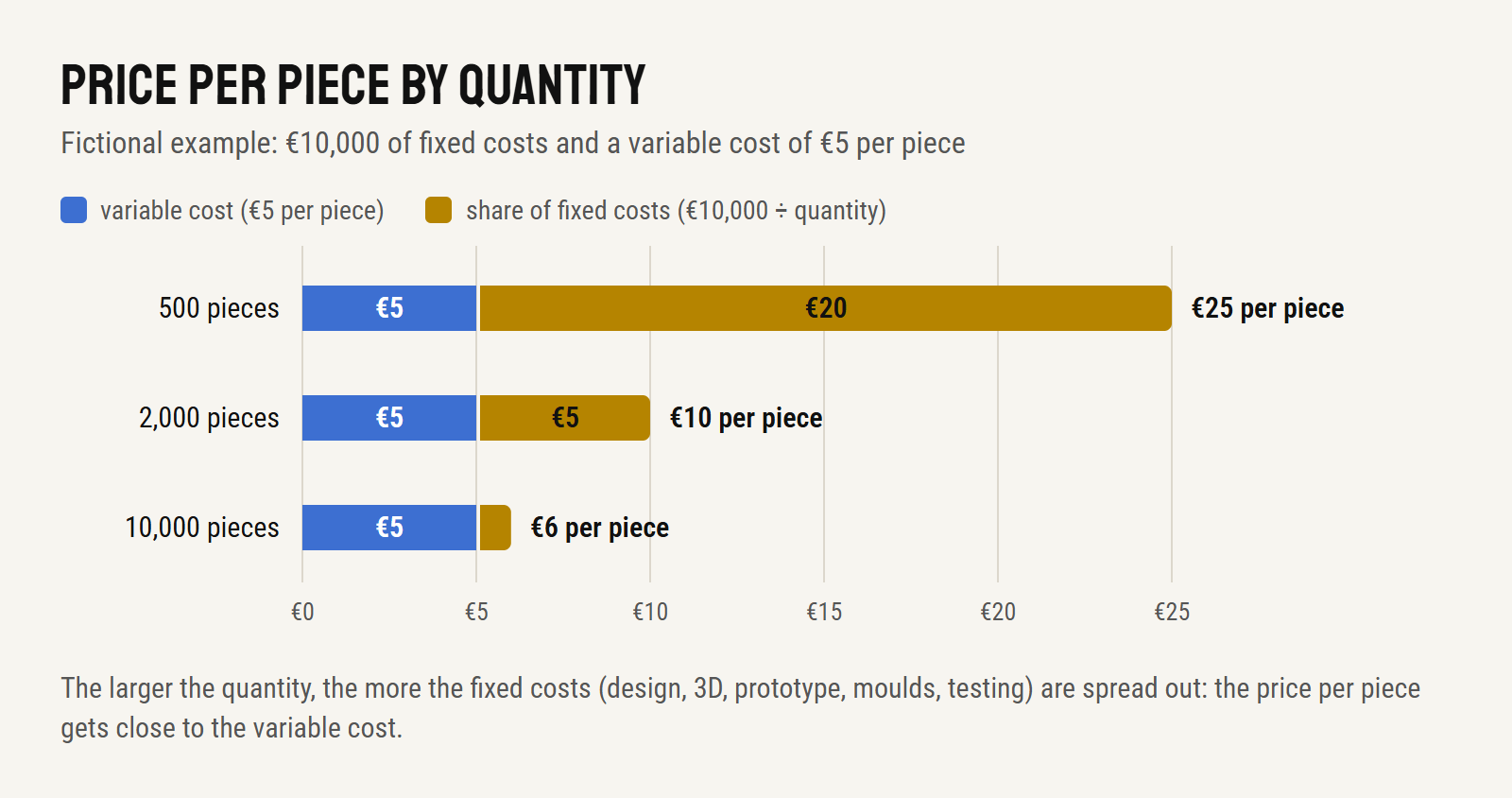
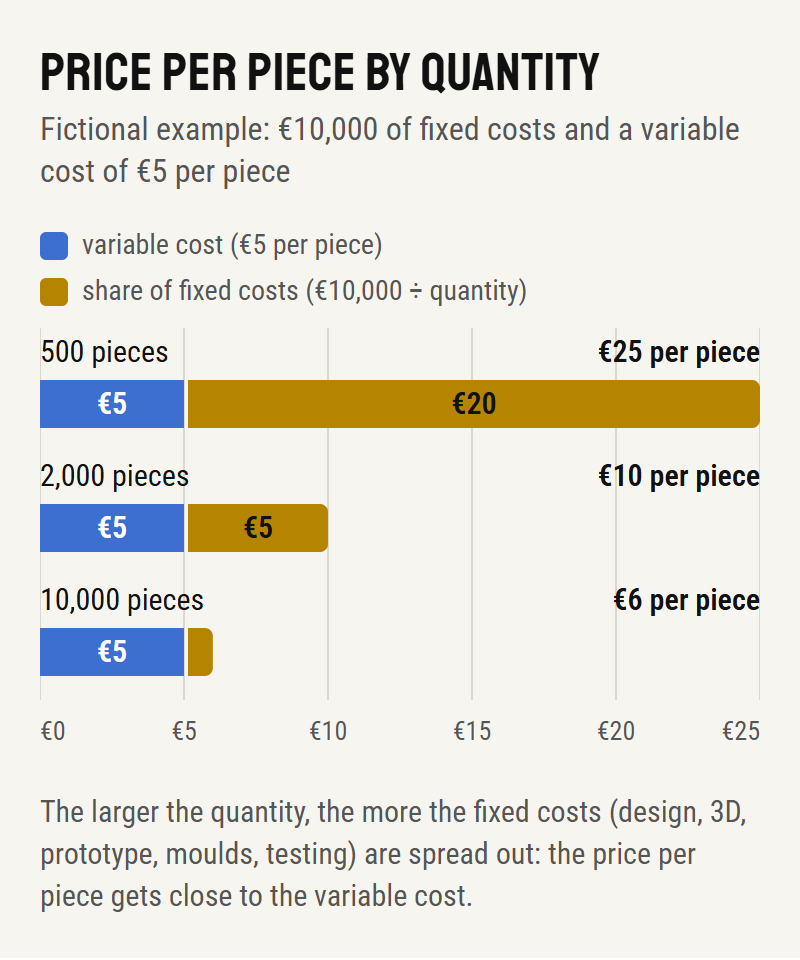
The same fictional example as a chart: the share of fixed costs shrinks as the quantity grows.
Beyond a certain volume, the share of fixed costs becomes almost negligible: the unit price gets close to the variable cost, and that is what you need to optimise. It is also from that point that PVC injection, despite its expensive moulds, becomes the cheapest technique.
Conversely, for very small runs, it is the fixed costs you need to reduce: that is the whole point of resin and silicone moulds, a technique we do not offer (our runs start at 300 pieces, in vinyl). Our guide to the minimum order quantity for custom figures helps you find the right balance.
Which choices push the budget up or down?
| Choice | Pushes the budget up | Brings the budget down |
|---|---|---|
| Size | Large figure, lots of material | Compact figure |
| Parts | Many parts to assemble | Few parts, simple shapes |
| Colours | Many colours and patterns | Reduced palette, flat colours |
| Effects | Metallic, flocking, hand painting | Standard finish |
| Packaging | Collector box, insert, certificate | Polybag or simple box |
| Timing | Air freight, tight schedule | Sea freight, time margin |
None of these choices is “good” or “bad”: a collector’s edition for a premium brand deserves a rigid box and a certificate, while a giveaway handed out in large numbers is better kept simple. What matters is making these choices knowingly.
How can you estimate your budget quickly?
- Set the quantity, even roughly: it is the input that changes the result most.
- Choose the size and a rough idea of the finish (matte art toy, highly detailed figure, statue).
- List your packaging and finishing needs.
- Run a simulation with our custom figure cost estimator: it gives you a range for the total budget, a unit price and an indicative lead time.
- Ask for a detailed quote: it will include your exact design, testing and shipping.
How can you reduce the cost without sacrificing quality?
- Simplify without impoverishing: a strong character often works with a few well-chosen colours. Our EQSO art toys play on flat colours and a very readable silhouette.
- Think about part splitting from the 3D stage: fewer parts means fewer moulds and less assembly.
- Share the moulds: several colourways of the same figure use the same tooling. That is what makes multi-colour series attractive.
- Plan ahead: a comfortable schedule allows sea freight, much cheaper than air.
- Match the packaging to the use: premium box for retail and collectors, polybag for giveaways.
What should you sell your figure for?
If the figure is meant to be sold, work backwards: start from the retail price your market accepts, then remove VAT or sales tax, your retailers’ margin, your own margin and selling costs. What is left is your maximum cost price.
For our own art toys, for example, a 12.5 cm vinyl figure in a limited edition sells for €55 and an 8–9 cm blind box for €18 per box: these retail prices guided our choices of size, material and packaging.
Want an accurate figure for your project? Discover our custom figure manufacturing service, or all our custom figure design and production services for brands.
Frequently asked questions
How much does a custom figure cost?
There is no single price: it depends on quantity, material, size, number of colours and packaging. For a first range tailored to your project, use our cost estimator. Market orders of magnitude, excluding tooling: over €20 per piece below 500 pieces, €6 to €10 at about 2,000 pieces in vinyl, under €5 from 5,000 pieces in PVC. At Popterror Studio, projects start from €10,000.
Why are moulds so expensive?
Because they are machined to measure, often from steel for injection, with great precision. They are a fixed investment, spread over every piece produced: that is why they weigh heavily on a small run and become light on a large one.
Is shipping included in the price?
It depends on the manufacturer. At Popterror Studio, shipping and customs are included in the quote, with a different price by sea or by air. In any case, remember import VAT or sales taxes in your overall budget.
Can you pay in instalments?
In manufacturing, it is common to pay a deposit with the order, then the balance. At Popterror Studio, you pay a deposit when the project starts and the balance when you receive the figures.
How can you lower the unit price?
Increase the quantity, reduce the number of colours and parts, choose simpler packaging, or share moulds between several figures or colourways. Each lever has a different impact on the result: we discuss them together from the brief.
Related guides
Read next
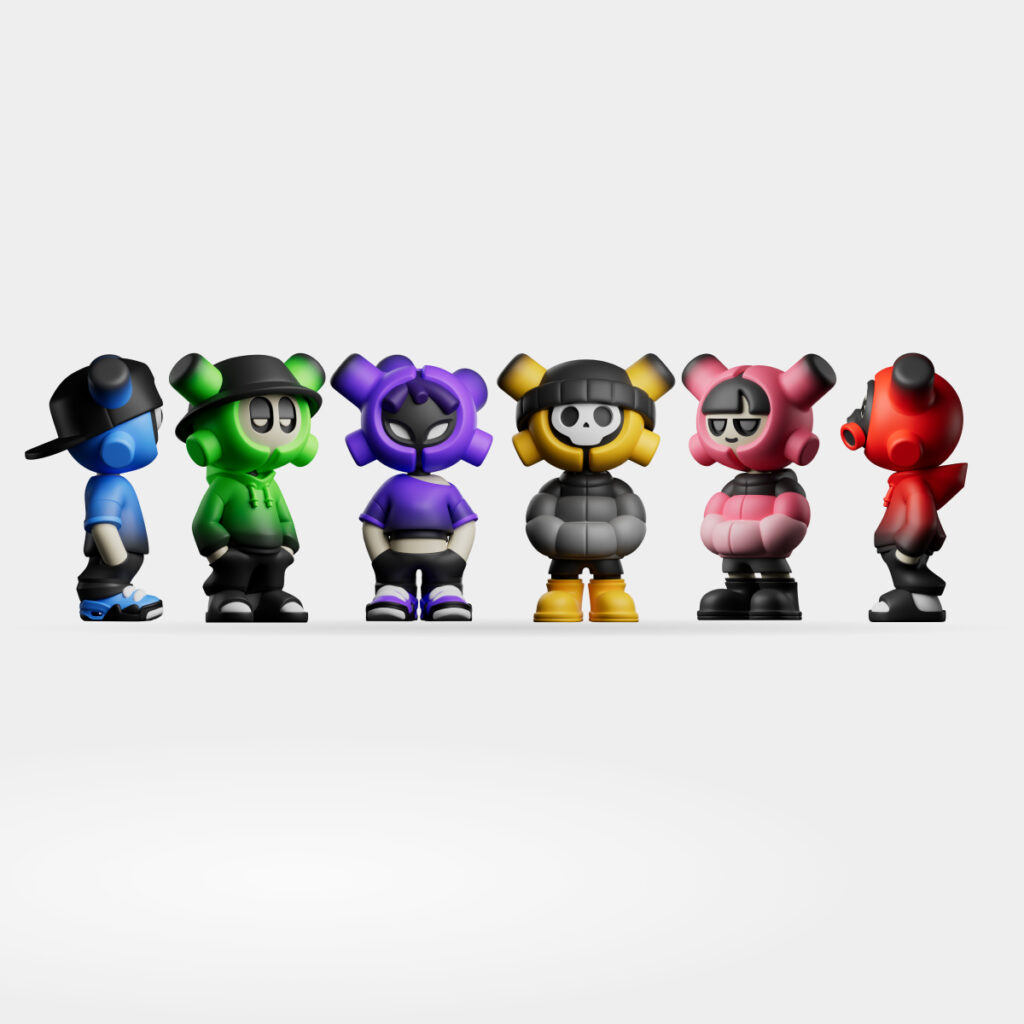
How to make custom figures: the complete guide, from idea to factory
How to make custom figures in series: character design, 3D modelling, prototype, materials, moulds, production, quality control, packaging and shipping.
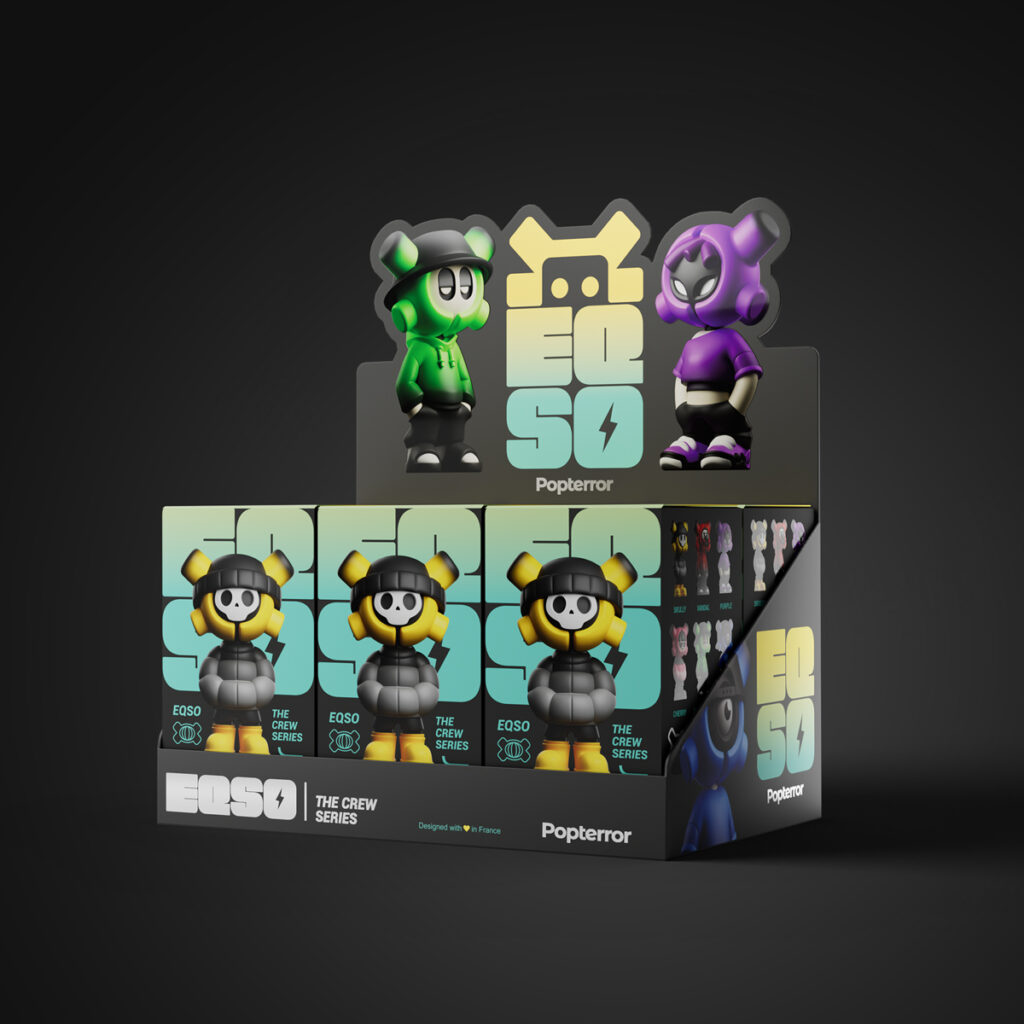
Minimum order quantity for custom figures: understanding MOQ
What is the minimum order quantity to make a custom figure? MOQ by technique (resin, vinyl, PVC), why it exists and how to choose the right quantity.
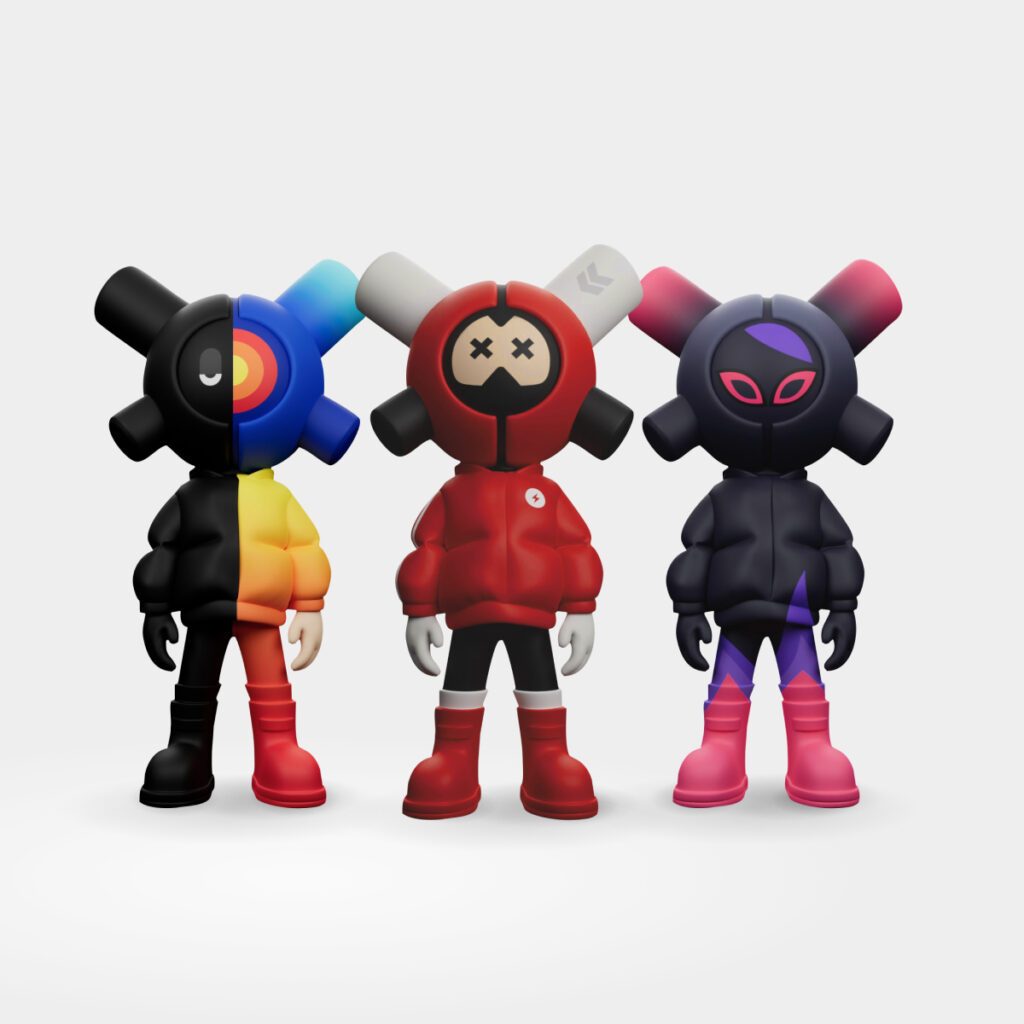
Vinyl vs PVC vs resin figures: which material should you choose?
Vinyl or resin figure? Rotocast vinyl, injected PVC and resin compared (finish, quantity, cost, lead time) to help you choose the right material.