Guide · Popterror Studio
Figure moulds (molds): steel, metal or silicone, how to choose?
 By Romain Czysz, 3D artist, co-founder of PopterrorPublished Updated Reading time: 4 min
The short answer
The mould (mold, in US spelling) depends on the manufacturing technique: a steel mould for PVC injection (expensive but almost indestructible, ideal for large runs), a metal mould for rotocast vinyl (medium to large runs) and a silicone mould for resin (cheap, but it wears out quickly, so it is kept for very small runs). The mould is often the biggest fixed cost of a figure project.
You never see moulds on a collector’s shelf, yet they decide the quality, the cost and even the minimum quantity of a figure. Understanding how they work helps you read a quote and make the right choices from the 3D modelling stage. (In US English, you will read “mold”: it is exactly the same thing.)
What is a figure mould for?
The mould is the “hollow” form in which the material takes the shape of your character. It is made from the approved 3D model (and the prototype), with a precision that determines everything else: a flaw in the mould will show on every piece produced.
A figure is rarely moulded in one block. Head, body, arms and accessories are often separate parts, each with its own mould or “cavity”, then assembled. That is why part splitting, planned from the 3D stage, has a direct impact on the number of moulds and therefore on the budget.
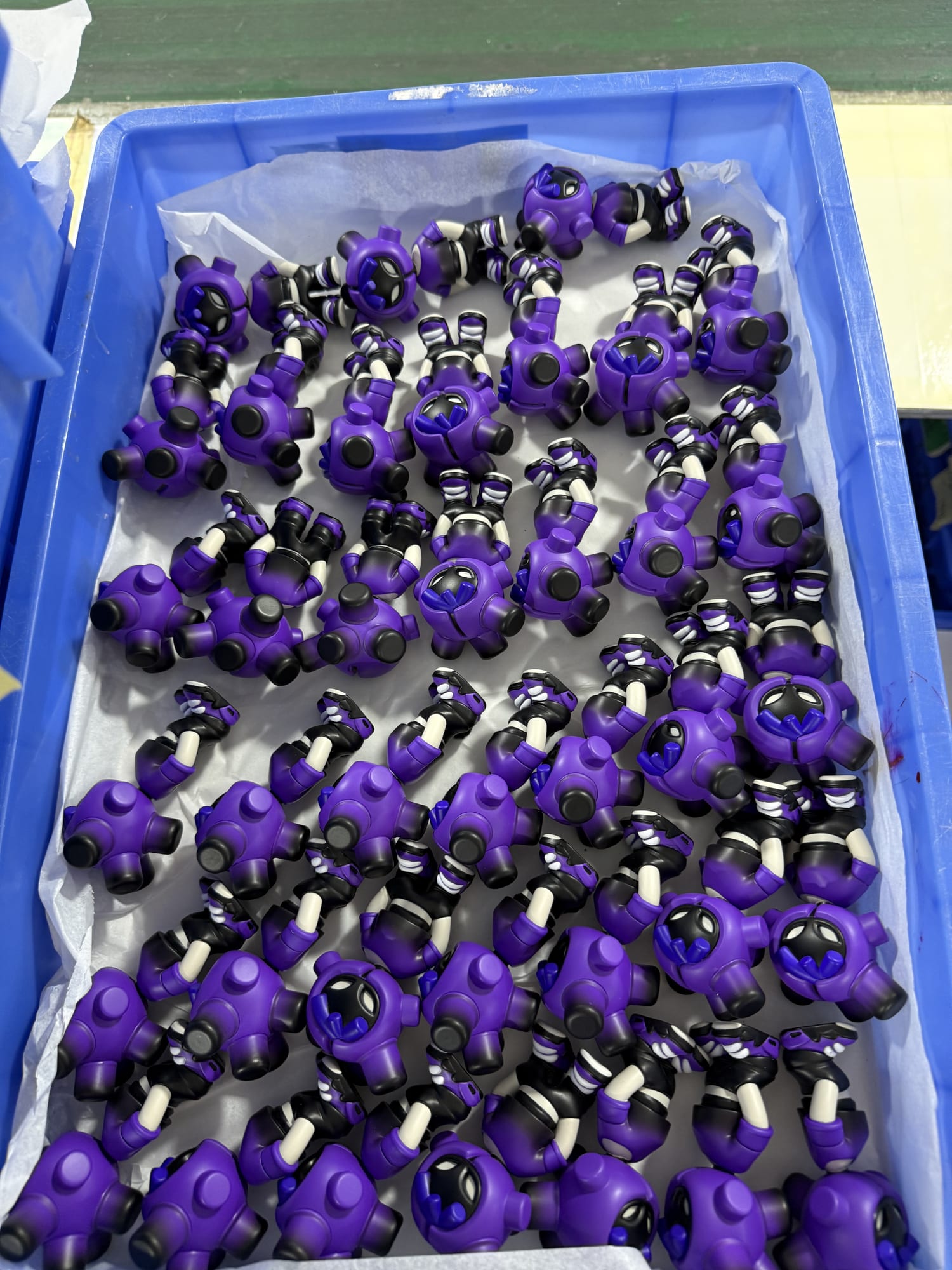
Heads and bodies of an EQSO The Crew figure: parts moulded separately, painted, then assembled.
What are the different types of moulds?
The steel injection mould
Used for injected PVC and rigid plastics. It is a steel block machined with great precision, into which molten material is injected under high pressure. It is expensive and slow to make, but extremely durable, and it produces very consistent parts very quickly. It is the tool of large runs.
The rotocasting mould
Used for rotocast vinyl. The mould, made of thinner metal, is filled with a small amount of liquid material, then heated and rotated: the material coats the walls and forms a hollow part. It costs less than an injection mould and suits medium to large runs. It is the technique used for our EQSO art toys.
The silicone mould
Used for resin. Silicone is poured around a master model (often the 3D-printed prototype): once cured, it forms a flexible mould into which resin is cast. It is cheap and quick to make, but it wears out after a limited number of casts and each piece has to be demoulded by hand.
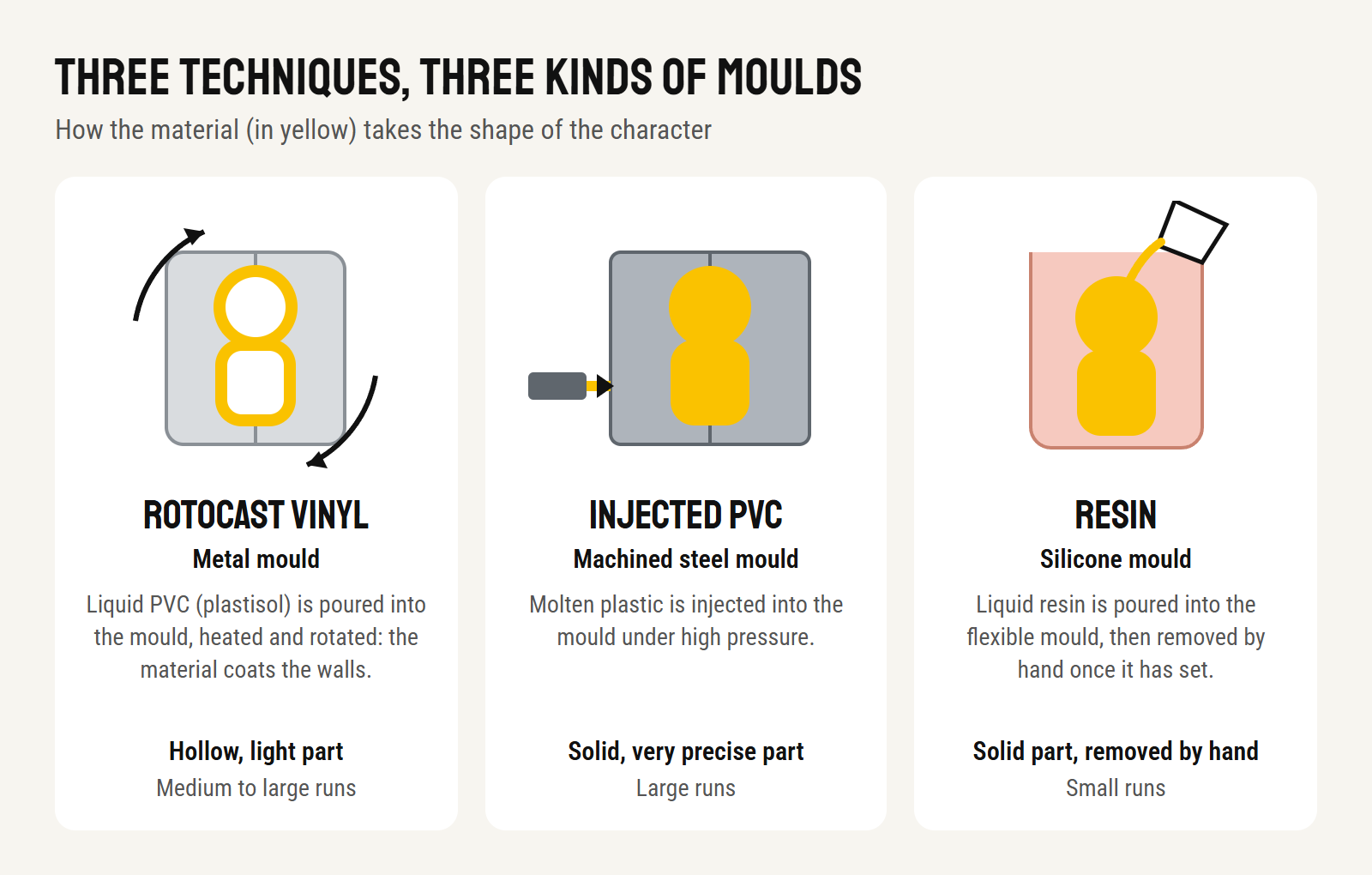
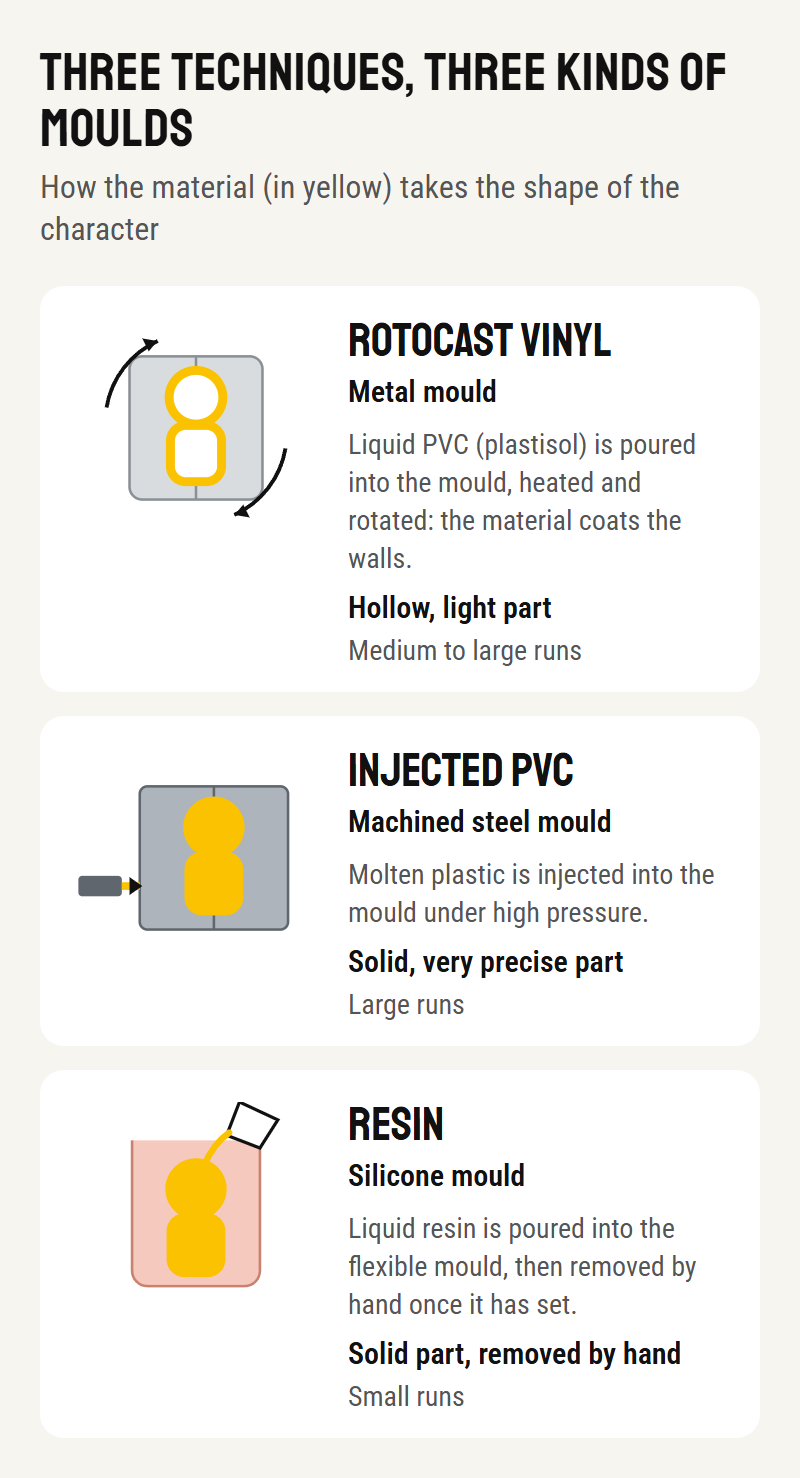
The three kinds of moulds and the part each one produces.
How do the moulds compare?
| Criterion | Steel (injection) | Metal (rotocasting) | Silicone (resin) |
|---|---|---|---|
| Material produced | PVC, rigid plastics | Soft vinyl | Resin |
| Cost to make | High | Medium | Low |
| Time to make | Long | Medium | Short |
| Lifespan | Very long | Long | Short |
| Level of detail | Very high | Good | Very high |
| Suitable run | Very large | Medium to large | Very small |
| Price range (market) | From around €3,000 | €1,500 to €3,500 per 15–20 cm figure | The cheapest of the three |
Why does the mould weigh so much in the budget?
Because it is a fixed cost: it is the same whether you produce 500 or 50,000 pieces. On a small run, it accounts for a large share of the price of each figure; on a large run, it becomes almost invisible. That is exactly what the unit price formula in our guide how much does it cost to make a custom figure? shows.
Three factors push the price of a mould up:
- the size of the figure: more metal, more machining;
- the number of parts: each separate part needs its own cavity;
- the complexity of the shapes: undercuts require multi-part moulds, with slides or inserts.
How can you reduce mould costs from the 3D stage?
- Limit the number of parts without sacrificing the design: an arm attached to the body rather than separate, an integrated accessory.
- Avoid unnecessary undercuts: a shape that “hooks” requires a more complex mould.
- Plan even wall thickness: it makes the mould easier to fill and limits defects.
- Reuse the moulds: the same body with several heads, or the same figure in several colourways, spreads the tooling cost better.
That is why 3D modelling must be designed for production from the start. The whole process is described in our guide on how to make custom figures.
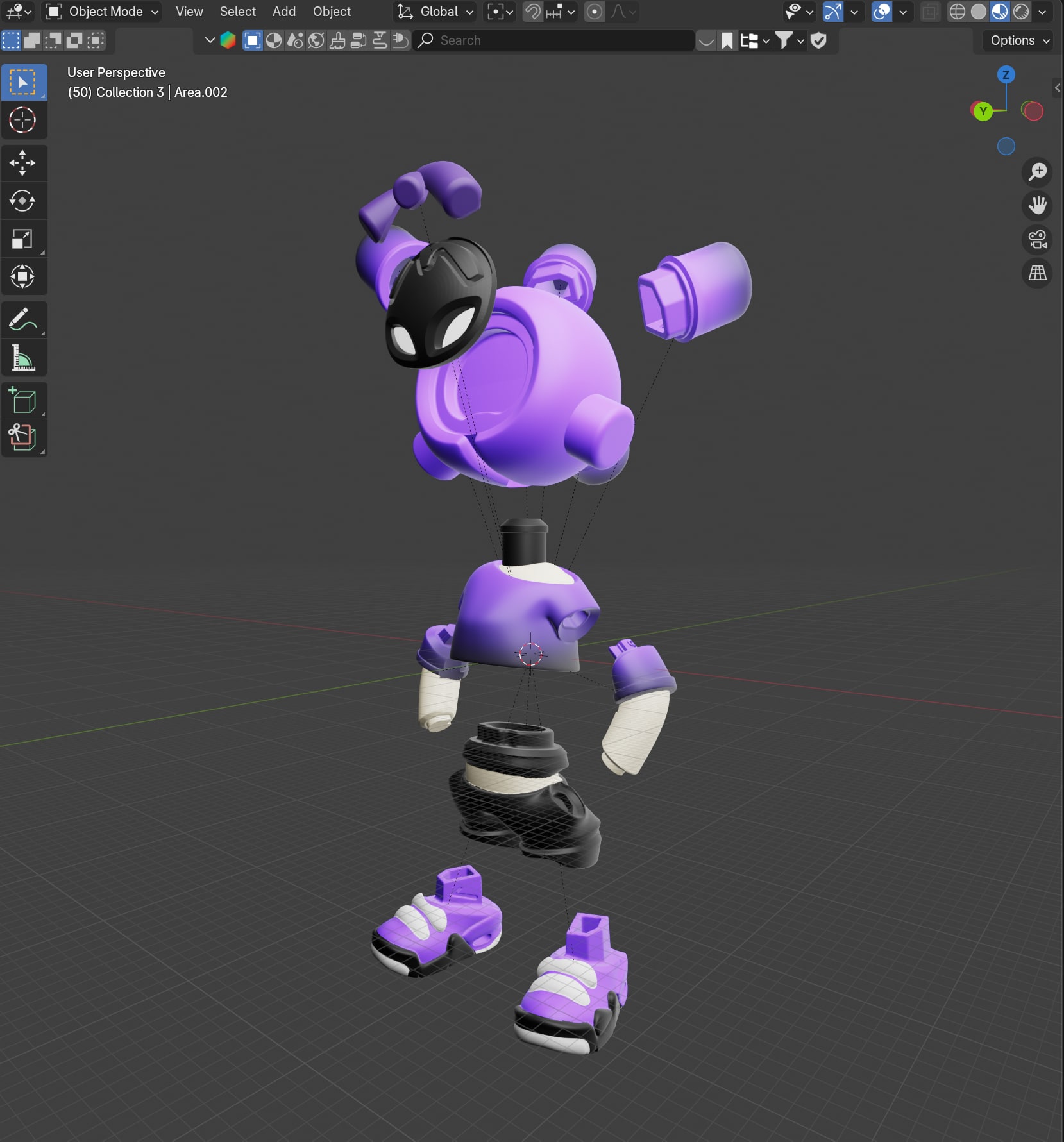
The 3D model of an EQSO The Crew figure in exploded view: the split into parts is decided at the 3D stage, and each part needs its own mould or cavity.
What is the pre-production sample?
Once the moulds are made, the factory produces a first “real” sample: right material, right paint, right assembly. This is the pre-production sample, or golden sample. You approve it (and ideally sign it off): it becomes the reference for the whole production. If a defect shows up at this stage, it is the last chance to adjust the mould at a reasonable cost.
What happens to the mould after production?
Generally, the mould stays with the manufacturer, who stores it for future production runs (reorder, new colour, special edition). It is important to state in writing who owns it, how long it is kept and on what terms it can be reused.
Have a 3D file and want to know which moulds it needs? That is the first step of our custom figure manufacturing service. Discover also our full offer of custom figure design and production for brands.
Frequently asked questions
How much does a figure mould cost?
The price depends on the technique (steel, metal for rotocasting, silicone), the size and the number of parts to mould. Market orders of magnitude: around €1,500 to €3,500 for the metal moulds of a 15–20 cm vinyl figure, from around €3,000 for a steel injection mould; a silicone mould costs much less but wears out quickly. Use our estimator to price your whole project.
Who owns the mould?
It is a point to settle in writing before production starts: who owns the mould, where it is stored, and on what terms it can be reused for a reorder.
How many pieces can a mould produce?
A steel injection mould can produce a very large number of pieces, while a silicone mould wears out after a few dozen casts. Indicative lifespans: several hundred thousand shots for a steel mould (300,000 and more depending on the steel), a few dozen casts for a silicone mould.
Can a mould be modified after it is made?
Minor adjustments are sometimes possible, especially removing material, but they are expensive and take time. Hence the importance of approving the prototype perfectly before launching the tooling.
Do you need one mould per colour?
No. The same mould can produce the same shape in several material or paint colours: that is what makes multi-colour series economically attractive.
Related guides
Read next

Vinyl vs PVC vs resin figures: which material should you choose?
Vinyl or resin figure? Rotocast vinyl, injected PVC and resin compared (finish, quantity, cost, lead time) to help you choose the right material.

How much does it cost to make a custom figure? Every cost explained
Custom figure cost explained: fixed costs (design, 3D, moulds), cost per piece, how quantity changes the unit price, and tips to keep your budget in check.

How to make custom figures: the complete guide, from idea to factory
How to make custom figures in series: character design, 3D modelling, prototype, materials, moulds, production, quality control, packaging and shipping.